C-CLASS SOLAR FLARE: Earth-orbiting satellites have just detected a minor C1-class solar flare: image. The source appears to be a new active region, probably a sunspot, hiding just behind the sun's eastern limb. Because the explosion was partially eclipsed by the edge of the sun, it was likely stronger than it appeared to be. Stay tuned for updates as the sun's rotation turns the blast site toward Earth for a better view this weekend. Free: Aurora Alerts.

METEOR SMOKE MAKES STRANGE CLOUDS: High above Earth, glowing clouds of frosted meteor smoke are spilling over populated areas of the USA and Europe. "Last night, for the first time this summer, noctilucent clouds stretched across our whole sky," reports Danish observer Pernille Fjeldgaard Jensen. "Some of the clouds looked like silver corkscrews spiraling their long arms towards us."

"It was a fantastic display," says Jensen, who took this picture from Denmark's Lille Vildmose Wild Life Park.
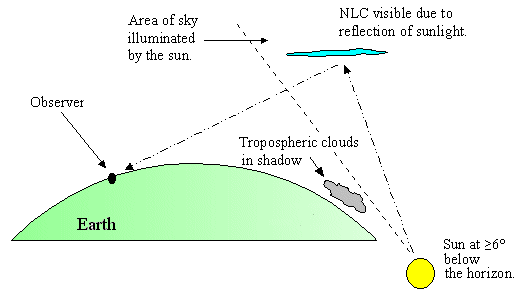
Noctilucent clouds (NLCs) form when summertime wisps of water vapor rise to the top of Earth's atmosphere and crystallize around specks of meteor smoke. Mesospheric winds gather the resulting ice crystals into clouds that float more than 80 km high. They can be seen long after sunset as they ripple and swirl across the night sky.
Observers in Europe have been seeing these clouds for more than a month. On July 4th, bright NLCs finally visited the continental USA. Dustin Guy saw the silvery forms spreading over Seattle:

"It was one of the most vivid noctilucent cloud displays I've seen in years," says Guy.
July is often the best month for NLCs with sightings in previous years as far south as Utah and Colorado. This week's display in Washington state means US observers may soon be able to join Europeans in their regular contributions to the NLC photo gallery.
Observing tips: Look west 30 to 60 minutes after sunset when the sun has dipped well below the horizon. If you see luminous blue-white tendrils spreading across the sky, you may have spotted a noctilucent cloud.
Realtime Noctilucent Cloud Photo Gallery
IRIDESCENT SPACE PYRAMID: Spaceweather.com and the students of Earth to Sky Calculus have been traveling around the world launching cosmic ray balloons to map Earth's radiation field. This runs up a big helium bill. To help pay it, we sent this iridescent crystal pyramid to the stratosphere:

You can have it for $149.95. The students are selling this pyramid and several others like it to fund the Earth to Sky ballooning program. Each one comes with a greeting card showing the pyramid in flight and telling the story of its journey to the edge of space. All sales support hands-on STEM research.
Far Out Gifts: Earth to Sky Store
All proceeds support hands-on STEM education
LUNAR RAINBOW CONTRAIL: Pilot and night-sky photographer Brian Whittaker has a knack for catching unusual sights from the cockpit as he flies back and forth from the USA to Europe. On July 3rd, he added "lunar rainbow contrail" to the list. "Although it was a beautiful evening seeing noctilucent clouds all night long from 38,000 feet, the coolest thing I saw was this iridescent contrail streaming from the wingtip of an Air France A380," says Whittaker.

"We were flying east of Newfoundland, Canada, when the rising Moon lit up the contrail, creating a rainbow-colored streamer with stars sparkling above," he says. "What a wonderful job."
Although the contrail was rainbow-colored, it was not technically a rainbow, which requires raindrops. The contrail was filled with ice. Vortices of air that swirl behind flying wingtips create a low-pressure zone where water from humid air can condense. Sub-freezing temperatures produce crystals of ice which, in this case, split the light of the rising moon into iridescent colors.