MARS VISIBLE IN BROAD DAYLIGHT: Astronomers have long known that the brightest planets can be seen with the naked eye in daylight. Usually this means Venus and Jupiter. Now Mars has joined the club. On July 6th in Trieste, Italy, Giorgio Rizzarelli saw the Red Planet with his unaided eye--a pinprick of dusty orange piercing the morning blue even after sunrise. He took these pictures, which simulate the view without optics. Browse: Mars Photo Gallery.
APPROACHING SUNSPOT: Today, the face of the sun is blank. Tomorrow, we may have a sunspot. An new active region is hiding just behind the eastern limb of the sun. NASA's Solar Dynamics Observatory photographed its magnetic canopy towering over the edge of the solar disk on July 7th:

At the bottom of those magnetic loops probably lies a dark sunspot, which yesterday unleashed a C-class solar flare. Solar rotation is turning the region toward Earth, and it could emerge into view as early as July 8th. Amateur astronomers with backyard solar telescopes are encouraged to monitor developments.
Realtime Space Weather Photo Gallery
ONE RING ABOVE HOBBITON: Two week ago, the students of Earth to Sky Calculus traveled to New Zealand for an unprecedented launch of space weather balloons over Earth's 8th continent. To help fund their trip, they sent this ring of power to the stratosphere:
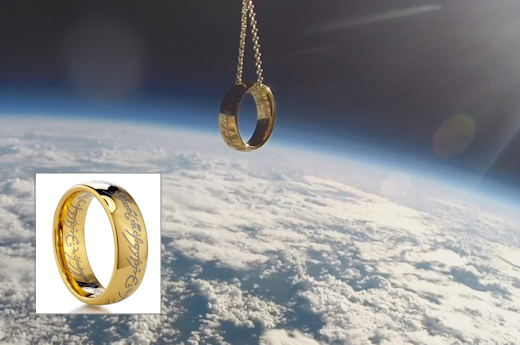
You can have it for $129.95. On the southern winter solstice, June 21st, the ring flew 109,580 feet above New Zealand's north island, passing almost directly above Hobbiton, the movie set for the Lord of the Rings. The band is made of golden-colored tungsten and inscribed with the authentic Mordor script of the One Ring. Along with the ring, you'll receive a greeting card showing the item in flight and telling the story of its journey to the edge of space.
Far Out Gifts: Earth to Sky Store
All proceeds support hands-on STEM education
LUNAR RAINBOW CONTRAIL: Pilot and night-sky photographer Brian Whittaker has a knack for catching unusual sights from the cockpit as he flies back and forth from the USA to Europe. On July 3rd, he added "lunar rainbow contrail" to the list. "Although it was a beautiful evening seeing noctilucent clouds all night long from 38,000 feet, the coolest thing I saw was this iridescent contrail streaming from the wingtip of an Air France A380," says Whittaker.
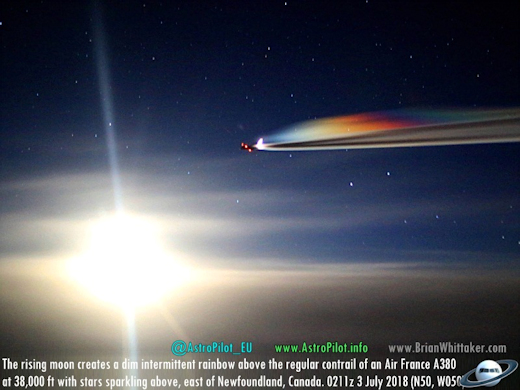
"We were flying east of Newfoundland, Canada, when the rising Moon lit up the contrail, creating a rainbow-colored streamer with stars sparkling above," he says. "What a wonderful job."
Although the contrail was rainbow-colored, it was not technically a rainbow, which requires raindrops. The contrail was filled with ice. Vortices of air that swirl behind flying wingtips create a low-pressure zone where water from humid air can condense. Sub-freezing temperatures produce crystals of ice which, in this case, split the light of the rising moon into iridescent colors.