TWO+ WEEKS WITHOUT SUNSPOTS: The sun has been without spots for 15 straight days. To find an equally long stretch of blank suns, you have to go all the way back to November 2009 when the sun was emerging from the deepest solar minimum in a century. However, 15 days without sunspots is not a long time. At the nadir of that century-class solar minimum in 2008, the sun was blank for 52 consecutive days. Conclusion: If this solar minimum is anything like the last one, the quiet is just beginning and we have a long way to go. Free: Aurora alerts.
FRIDAY THE 13TH SOLAR ECLIPSE: If you live in Tasmania, this Friday the 13th is your lucky day. The New Moon will pass in front of the sun, off center, taking a bite out of the solar disk. This video created by graphic artist Larry Koehn of ShadowandSubstance.com shows the circumstances of the partial eclipse:
The eclipse will be visible in a region stretching from the southernmost edge of Australia (2% coverage) to the northern coast of Antarctica (33% coverage). As the Moon's shadow crosses few inhabited areas, Hobart, Tasmania, arguably has the best combination of population (200,000) + coverage (10%). It will be interesting to see if we receive any photos of this remote event. Stay tuned!
Realtime Space Weather Photo Gallery
NOCTILUCENT CLOUDS OVER MOSCOW: How do noctilucent clouds (NLCs) differ from ordinary clouds? The answer may be found in the skies of Moscow. Photographer Vitaly Romejko took this picture from the Russian capital on June 26th:

"Noctilucent clouds were glowing very brightly over Moscow when some ordinary clouds drifted beneath them," says Romejko. "I captured both types in a single shot--the dark rainclouds silhouetted against the glowing NLCs."
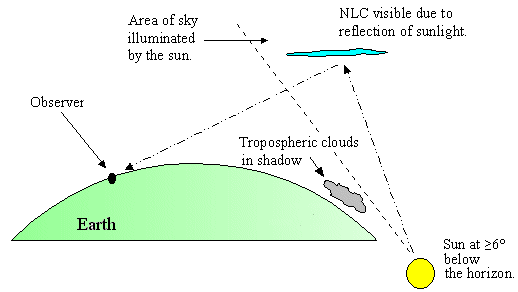
In a word, the difference is altitude. Noctilucent clouds are Earth's highest clouds. Seeded by meteor smoke at the edge of space, they float more than 80 km above our planet's surface. At that extreme altitude, they can catch the rays of the sun even after darkness has fallen across ground below. That's how they are able to glow at night. Ordinary clouds, on the other hand, hug the planet's surface, floating no more than 5 or 10 km high. When darkness falls across the ground, they darken, too.
Summer is the season for noctilucent clouds and they are now being sighted at latitudes from Scandinavia to Seattle. Observing tips: Look west 30 to 60 minutes after sunset when the sun has dipped well below the horizon. If you see luminous blue-white tendrils spreading across the sky, you may have spotted a noctilucent cloud.
Realtime Noctilucent Cloud Photo Gallery
ONE RING TO RULE THE STRATOSPHERE: Two weeks ago, the students of Earth to Sky Calculus traveled to New Zealand for a launch of space weather balloons over Earth's 8th continent. To help fund their trip, they sent this ring of power to the stratosphere:

You can have it for $129.95. On the southern winter solstice, June 21st, the ring flew 109,580 feet above New Zealand's north island, passing almost directly above Hobbiton, the movie set for the Lord of the Rings. The band is made of golden-colored tungsten and inscribed with the authentic Mordor script of the One Ring. Along with the ring, you'll receive a greeting card showing the item in flight and telling the story of its journey to the edge of space.
Far Out Gifts: Earth to Sky Store
All proceeds support hands-on STEM education