SUNSET PLANETS: When the sun goes down tonight, step outside and look west. An exquisitely slender crescent Moon is passing by Mercury in the rosy glow of sunset. Tomorrow night is even better when the Moon passes by Venus. Enjoy the show. Sky maps: July 14, 15.


GREEN FLASH ON THE SUN: For seaside photographers, nothing beats a green flash--that sudden pulse of verdant light at sunset as the sun vanishes beneath the ocean waves. James Young was on a beach in Oregon on July 11th when captured a green flash. But it didn't come from the ocean waves. It came from the top of a cloud:

This is a rare 'cloud-top' green flash, sometimes seen as the sun's rays graze a distant cloud bank. They are not well understood. Ordinary green flashes require a temperature inversion layer near the sea surface. Similar inversions may sometimes occur at the top of marine stratus clouds, giving rise to the type of ragged green flash Young witnessed.
"It was very bright--a beautiful mystery to end the day," he says.
Realtime Green Flash Photo Gallery
GREEN FLASH ON MARS: Mars is approaching Earth for a 15-year close encounter on July 27th. The Red Planet now outshines every object in the sky except the sun, Moon, and Venus. Mars is doing things only very luminous objects can do--like produce a green flash. Watch this video taken by Peter Rosén of Stockholm, Sweden, on July 12th:
  |
"Mars was shining brightly in the early morning sky," he says. "At an altitude of only 6.5° above the horizon, the turbulence was extreme, sometimes splitting the planet's disc in 2 or 3 slices and displaying a green and blue flash resembling those usually seen on the sun."
That's not all. Mars is also making its own glitter paths. Last night, Alan Dyer photographed this specimen from Driftwood Beach at Waterton Lakes National Park, Alberta:

A glitter path is a band of light in the water. It is caused by reflections from the troughs and crest of tiny waves. Normally, only the sun and Moon (and sometimes Venus and Jupiter) produce glitter paths. Now Mars is doing it too.
Dyer notes that Mars was "bright yellow"--a hue caused in part by the massive global dust storm in progress there. Think about it: A dust storm on another planet that you can see with your naked eye. Mars is close.
Still two weeks before closest approach, Mars is almost 3 times brighter than Sirius, the brightest star in the sky, and 30% brighter than the giant planet Jupiter. In other words, you can't miss it. Look south at midnight and remember, the best is yet to come. [sky map]

Realtime Space Weather Photo Gallery
FLY ME TO THE MOONSTONE: Are you looking for a far-out gift? Nothing says "I love you" like a moonstone from the edge of space. On June 12th, the students of Earth to Sky Calculus flew this moonstone wrapped in a sterling silver Celtic love knot 34.1 km (111,877 feet) above Earth's surface:
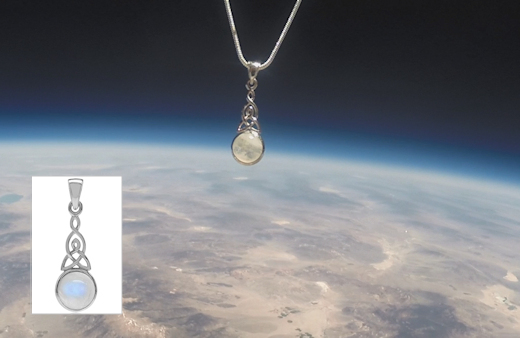
You can have it for $119.95. The students are selling these pendants to support their cosmic ray ballooning program. Each one comes with a greeting card showing the item in flight and telling the story of its journey to the edge of space. Sales support the Earth to Sky Calculus cosmic ray ballooning program and hands-on STEM research.
Far Out Gifts: Earth to Sky Store
All sales support hands-on STEM education