19 DAYS WITHOUT SUNSPOTS: The sun is without spots for the 19th straight day. To find an equal stretch of blank suns, you have to go all the way back to September of 2009 when the sun was emerging from the deepest solar minimum in a century. The current stretch of spotlessness is a sign that the sun is entering another solar minimum, possibly as deep as the last one. Stay tuned. Free: Aurora Alerts.
RED SPRITES OVER THE USA: Around Earth's northern hemisphere, thunderstorm season is in full swing. That means it's a great time to see sprites. Paul Smith photographed these specimens on July 14th:
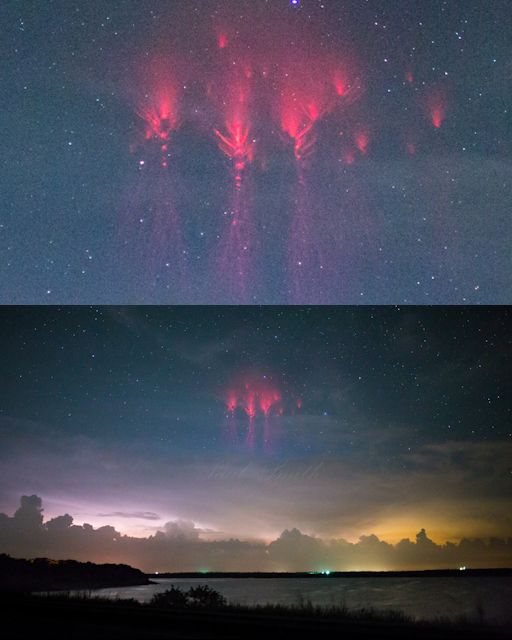
"I was at Kaw Lake in Oklahoma when the sprites started leaping up from the thunderheads," says Smith.
Sprites are an exotic form of upward-directed lightning, reaching from the tops of electrical storms all the way up to the edge of space. Because they emerge from the tops of storms, the best place to see sprites is from a distance where the camera can point over the edge of the thunderhead.

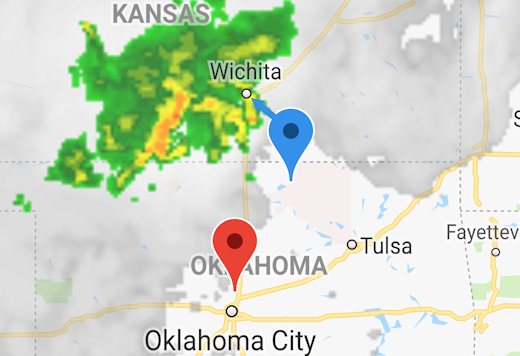
"I was about 140 miles from the storm in Kansas that produced these sprites," says Smith. This weather map shows the location of his camera (blue pushpin) and where it was pointing (blue arrow):
People have been seeing sprites since at least the 19th century, but the first reports were met with skepticism. Sprites entered the mainstream in 1989 when researchers from the University of Minnesota finally captured them on film. Subsequent video footage from the space shuttle cemented their status as an authentic physical phenomenon.
In recent years, citizen scientists like Smith have been photographing sprites in record numbers. One reason is raised awareness. More photographers know about sprites, so more sprites are being photographed. Another reason might be a genuine increase in sprite activity. Some researchers think that sprites are linked to cosmic rays. Subatomic particles from deep space strike the top of Earth's atmosphere, producing secondary electrons that trigger the upward bolts. Cosmic rays are now intensifying due to the decline of the solar cycle. More sprites, anyone?
FLY ME TO THE MOONSTONE: Are you looking for a far-out gift? Nothing says "I love you" like a moonstone from the edge of space. On June 12th, the students of Earth to Sky Calculus flew this moonstone wrapped in a sterling silver Celtic love knot 34.1 km (111,877 feet) above Earth's surface:
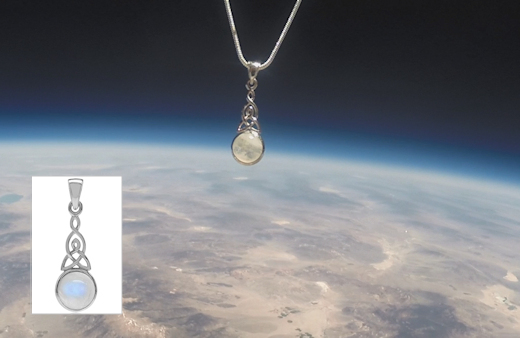
You can have it for $119.95. The students are selling these pendants to support their cosmic ray ballooning program. Each one comes with a greeting card showing the item in flight and telling the story of its journey to the edge of space. Sales support the Earth to Sky Calculus cosmic ray ballooning program and hands-on STEM research.
Far Out Gifts: Earth to Sky Store
All sales support hands-on STEM education
MOON-VENUS CONJUNCTION: Last night, the crescent Moon passed Venus less than 1 degree away in the sunset skies of North America. Alex Barnedt photographed the meeting from West Bountiful, Utah:

"We watched and took pictures as the bright pair were pulled together in the sky," says Barnedt. "It was a wonderful show."
The show's not over. Now the Moon is moving away from Venus, forming a long line in the sky composed of the lunar crescent, Venus, Regulus and Mercury. Look west after sunset for the new arrangement. Sky maps: July 15, 16.


Realtime Space Weather Photo Gallery