A HOLE IN THE SUN'S ATMOSPHERE: HIgh-latitude auroras are possible on July 20-21 when a stream of solar wind is expected to hit Earth's magnetic field. The gaseous material is flowing from a hole in the sun's atmosphere. NOAA forecasters estimate a 40% chance of minor geomagnetic storms. Free: Aurora Alerts.

THREE WEEKS WITHOUT SUNSPOTS: The sun has been blank for 21 days--3 whole weeks without sunspots. To find an equal number of consecutive spotless days in the historical record, you have to go back to July-August 2009 when the sun was emerging from an unusually deep solar minimum. Solar minimum, welcome back!

Above: The spotless sun photographed by NASA's Solar Dynamics Observatory
Solar minimum is a normal part of the solar cycle. Every 11 years, sunspot production sputters. Dark cores that produce solar flares and CMEs vanish from the solar disk, leaving the sun blank for long stretches of time. These quiet spells have been coming with regularity since the sunspot cycle was discovered in 1843.
However, not all solar minima are alike. The last one in 2008-2009 surprised observers with its depth and side-effects. Sunspot counts dropped to a 100-year low; the sun dimmed by 0.1%; Earth's upper atmosphere collapsed, allowing space junk to accumulate; and the pressure of the solar wind flagged while cosmic rays (normally repelled by solar wind) surged to Space Age highs. These events upended the orthodox picture of solar minimum as "uneventful."
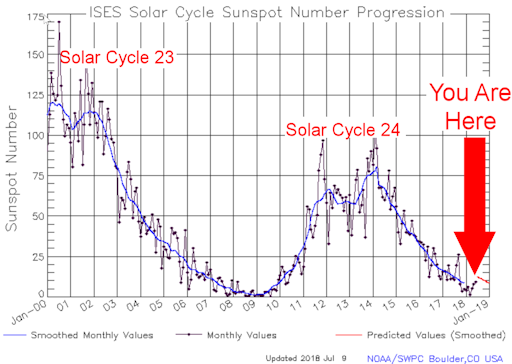
Space weather forecasters have long wondered, will the next solar minimum (2018-2020) be as deep as the previous one (2008-2009)? Twenty-one days without sunspots is not enough to answer that question. During the solar minimum of 2008-2009, the longest unbroken interval of spotlessness was ~52 days, adding to a total of 813 intermittent spotless days observed throughout the multi-year minimum. The corresponding totals now are only 21 days and 244 days, respectively. If this solar minimum is like the last one, we still have a long way to go.
How does this affect us on Earth? Contrary to popular belief, auroras do not vanish during solar minimum. Instead, they retreat to polar regions and may change color. Arctic sky watchers can still count on good displays this autumn and winter as streams of solar wind buffet Earth's magnetic field. The biggest change brought by solar minimum may be cosmic rays. High energy particles from deep space penetrate the inner solar system with greater ease during periods of low solar activity. NASA spacecraft and space weather balloons are already detecting an increase in radiation. Cosmic rays alter the flow of electricity through Earth's atmosphere, trigger lightning, potentially alter cloud cover, and dose commercial air travelers with extra "rads on a plane."
At the moment there are no nascent sunspots on the solar disk, so the spotless days counter is likely to keep ticking. Stay tuned for more blank suns.
Realtime Space Weather Photo Gallery
FLY ME TO THE MOONSTONE: Are you looking for a far-out gift? Nothing says "I love you" like a moonstone from the edge of space. On June 12th, the students of Earth to Sky Calculus flew this moonstone wrapped in a sterling silver Celtic love knot 34.1 km (111,877 feet) above Earth's surface:
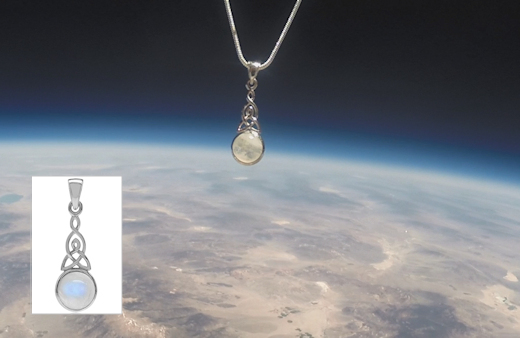
You can have it for $119.95. The students are selling these pendants to support their cosmic ray ballooning program. Each one comes with a greeting card showing the item in flight and telling the story of its journey to the edge of space. Sales support the Earth to Sky Calculus cosmic ray ballooning program and hands-on STEM research.
Far Out Gifts: Earth to Sky Store
All sales support hands-on STEM education
SPOTLESS SUN SPARKS AURORAS: No sunspots? No problem. On July 16th a disturbance in the solar wind rattled Earth's magnetic field, sparking auroras over Canada and some northern-tier US states. Alan Dyer photographed the display from Bow Lake in Banff, Canada:
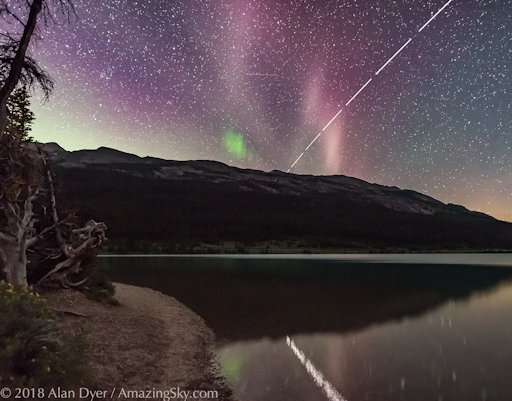
"What a surprise," says Dyer. "Although the K-index was barely above 2, we saw not only a normal auroral arc, but also STEVE."
Short for "Strong Thermal Emission Velocity Enhancement," STEVE is a cousin of the aurora borealis. To the naked eye it looks like a pale pink or mauve ribbon of light cutting across the sky. Underlying the luminous ribbon is a hot (3000 degrees C) stream of ionized gas slicing through Earth's upper atmosphere some 300 km above the ground. It appears unpredictably during some, but not all, geomagnetic storms.
"During the STEVE show, the ISS made a pass, flying to the east toward STEVE," notes Dyer. "One wonders if anyone was looking down and might have seen STEVE from above?!"
