THE SUN REMAINS BLANK: The spotless days counter continues to tick. The sun has now been without sunspots for 22 consecutive days--an almost decade-class event. To find an equally-long stretch of spotless suns, you have to go back to July 2009 when the sun was emerging from an unusually deep solar minimum. The return of solar minimum in 2018 brings with it extra cosmic rays, a slightly dimmer sun, and a chance of pink auroras. Free: Aurora Alerts.
A HOLE IN THE SUN'S ATMOSPHERE: NOAA forecasters say there is a 40% chance of geomagnetic activity late on July 20th when a stream of solar wind hits Earth's magnetic field. The gaseous material is flowing from a hole in the sun's atmosphere, shown here in an extreme ultraviolet image from NASA's Solar Dynamics Observatory:

This is a "coronal hole"--a region where the sun's magnetic field opens up and allows solar wind to escape. It looks dark because the hot glowing gas normally contained therein has left the sun.
The stream of solar wind en route to Earth is probaby preceded by a co-rotating interaction region (CIR). CIRs are transition zones between slow- and fast-moving solar winds. They contain shock-like density gradients and strong magnetic fields that often do a good job sparking high-latitude auroras. Free: Aurora Alerts.
Realtime Space Weather Photo Gallery
FLY ME TO THE MOONSTONE: Are you looking for a far-out gift? Nothing says "I love you" like a moonstone from the edge of space. On June 12th, the students of Earth to Sky Calculus flew this moonstone wrapped in a sterling silver Celtic love knot 34.1 km (111,877 feet) above Earth's surface:
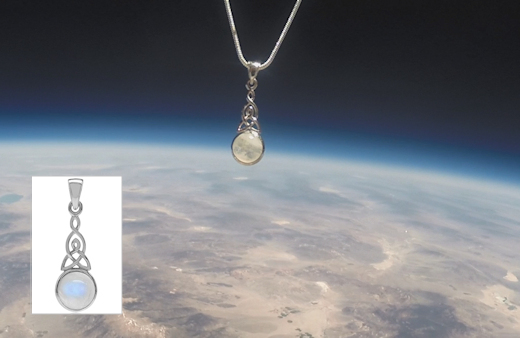
You can have it for $119.95. The students are selling these pendants to support their cosmic ray ballooning program. Each one comes with a greeting card showing the item in flight and telling the story of its journey to the edge of space. Sales support the Earth to Sky Calculus cosmic ray ballooning program and hands-on STEM research.
Far Out Gifts: Earth to Sky Store
All sales support hands-on STEM education