A HOLE IN THE SUN'S ATMOSPHERE: NOAA forecasters say there is a 40% chance of geomagnetic activity on July 20th when a stream of solar wind hits Earth's magnetic field. The gaseous material is flowing from a hole in the sun's atmosphere. High latitude sky watchers may be able to see auroras during the hours around local midnight Free: Aurora Alerts.

SPIDERS AND SPACE WEATHER: Did you know that spiders can fly? Biologists call it "ballooning." Spiders spin a strand of silk, it juts into the air, and off they go. Airborne arachnids have been found as high as 4 km off the ground. Originally, researchers thought spiders were riding currents of air, but there's a problem with that idea. Spiders often take flight when the air is calm, and large spiders fly even when air currents are insufficient to support their weight. It's a mystery.

Above: Just before ballooning, spiders adopt a posture shown here called "tiptoeing."
Scientists from the University of Bristol may have found the solution. In a paper published in the July 5th edition of Current Biology, they proved that spiders can propel themselves using electric fields.
"We exposed adult Linyphiid spiders (Erigone) to electric fields similar to those which naturally occur in Earth's atmosphere," explains the paper's lead author, Erica Morley. "Spiders showed a significant increase in ballooning in the presence of electric fields." A remarkable video of their experiment shows one spider flying when the fields were switched on, then sinking when the fields were off again.

Above: This diagram, borrowed from K. A. Nicoll's review paper "Space Weather influences on Atmospheric Electricity," illustrates the role of thunderstorms and cosmic rays in creating Earth's electric fields.
The electric fields spiders use for propulsion are part of Earth's global atmospheric electric circuit (GEC)–a planet-sized circuit of electricity that researchers have known about since the 1920s. In a nutshell, thunderstorms help build up a charge difference between the ground and the ionosphere 50 km overhead. The voltage drop is a staggering 250,000 volts. This sets up electric fields linking Earth to the edge of space. Cosmic rays ionize Earth's atmosphere, turning it into a weak conductor that allows currents to flow through the GEC.
Scroll down for the rest of the story.....
A MAGIC RING IN THE STRATOSPHERE: There are only a few left. Last month, the students of Earth to Sky Calculus launched a space weather balloon to the stratosphere over New Zealand. In the payload, alongside cosmic ray sensors, were rings of power. Here's one flying 108,345 feet above Hobbiton, the movie set for the Lord of the Rings:
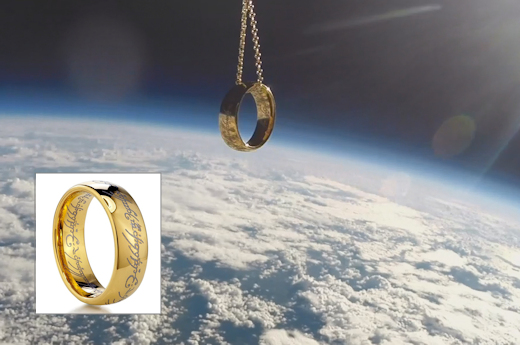
You can have one for $149.95. The ring is made of golden-colored tungsten and inscribed with the authentic Mordor script of the One Ring. This far out gift comes with a greeting card showing the ring in flight and telling the story of its journey to the edge of space. Sales support the Earth to Sky Calculus cosmic ray ballooning program and hands-on STEM research.
Far Out Gifts: Earth to Sky Store
All sales support hands-on STEM education
SPIDERS AND SPACE WEATHER, CONTINUED..... Spiders evolved inside the global electric circuit, so it's no surprise that they have learned to tap into it. But how? Peter W. Gorham of the Dept. of Physics and Astronomy at the University of Hawaii notes that "the complex protein structure of spider silk includes charge-bearing amino acids glutamic acid and arginine, which might be generated in a charged state as part of the spinning process." [ref]
This video shows a spider flying in respond to laboratory electric fields. From "Electric Fields Elicit Ballooning in Spiders."
Researchers have long wondered about the role of electricity in spider flight. Charles Darwin may have been the first. He wrote about it during his voyages on the HMS Beagle (1831-1836). One day, the ship was 60 miles off the coast of Argentina when the deck was inundated by ballooning spiders.
"The day was hot and apparently quite calm," Darwin wrote. Yet "I repeatedly observed the same kind of small spider, either when placed or having crawled on some little eminence, elevate its abdomen, send forth a thread, and then sail away horizontally, but with a rapidity which was quite unaccountable."
He was particularly struck by spiders using multiple strands of silk that splayed out in fan-like shapes. Instead of tangling as they moved through the air, the strands remained separate. Were they repelled by an electrostatic force? Darwin wondered in his writings. The work of Erica Morley and her collaborator Daniel Robert closes the loop on a train of thought almost 200 years old.

Above: Hairs on the legs of spiders called "trichobothria" twitch when electric fields are present–a signal to the spider that ballooning may commence. From "Electric Fields Elicit Ballooning in Spiders."
All of this raises the possibility that spiders may be affected by space weather as electric fields are perturbed by cosmic rays and solar activity. Research groups have demonstrated connections between space weather and atmospheric electricity on a variety of time scales:
- Days: Coronal mass ejections (CMEs) from the sun can sweep aside cosmic rays as they pass by Earth, causing temporary reductions in atmospheric ionization as large as 30%. Our own Spaceweather.com/Earth to Sky cosmic ray balloons have measured these events. [ref]
- Months: Measurements at the Reading University Atmospheric Observatory in the UK have shown that voltages can fluctuate +-15% as Earth dips in and out of the heliospheric current sheet (a huge corrugated magnetic structure centered on the sun) every ~27 days. [ref]
- Years: During the 20th century, fair weather atmospheric voltages at sites in Scotland and the UK decreased by factors of ~25% due to a long-term decrease in cosmic rays. [ref] That slow trend is now reversing itself as cosmic rays intensify again.
Could the migration patterns of ballooning spiders be affected by space weather?
"It's entirely possible, but we simply don't yet know," says Morley. "The experiments we have carried out are mostly lab-based, which helps eliminate confounding variables. A next step in the project is to take this all into the field and look for patterns. Factoring in solar activity could be very interesting."
A sharable permalink to this article may be found here.
Realtime Space Weather Photo Gallery