SPOTLESS SUN: Over the weekend, a small sunspot (AR2716) ended a 24-day string of blank suns. The interruption was brief. After only one day, the sunspot has dissolved and the spotless days counter is ticking again: 112 days so far in 2018 without sunspots. It's been 9 years since sunspots were this scarce, a sign that solar minimum has arrived. Free: Aurora Alerts.
NOCTILUCENT RADIO ECHOES: High above the Arctic Circle, the glow of the midnight sun prevents observers from seeing night-shining (noctilucent) clouds--even though the clouds are directly overhead. Rob Stammes of Lofoton, Norway, is under that dome of sunlight. He detects noctilucent clouds using radio waves. Last night, July 22-23, there was quite an outburst:

"I had the strongest Polar Mesospheric Summer Echo signals on my instruments this season," says Stammes. "The signals could be heard for a long time."
Polar Mesospheric Summer Echoes (PMSEs) are terrestrial radio stations reflected from an altitude of 80 km to 90 km--the same place noctilucent clouds are found. The exact cause of PMSEs is not yet known. Theorists have proposed explanations ranging from steep electron density gradients and "dressed aerosols" to gravity waves and turbulence. Strong echoes are almost always accompanied by visible noctilucent clouds.
Indeed, Stammes notes a number of entries in the Noctilucent Cloud Photo Gallery around the time of the outburst. "The relation between radio PMSEs and visible noctilucent clouds was very clear last night," he says.
Realtime Noctilucent Cloud Photo Gallery
GEOMAGNETIC STORM PREDICTED: NOAA forecasters say there is a 65% chance of minor G1-class geomagnetic storms on July 24th when a high-speed stream of solar wind is expected to hit Earth's magnetic field. The gaseous material is flowing from a large hole in the sun's atmosphere, shown here in an extreme ultraviolet image from NASA's Solar Dynamics Observatory:


This is a "coronal hole," a vast region in the sun's atmosphere where magnetic fields open up and allow solar wind to escape. They look dark in ultraviolet images because the hot glowing plasma normally contained there is missing. In this case, the plasma is making a beeline for Earth.
Some readers have asked, how can we have a geomagnetic storm during solar minimum? It happens all the time. Sunspots, whose counts define the solar cycle, are not the only source of storms. When sunspots vanish, coronal holes replace them as a primary source of solar activity. Studies show that coronal holes not only open more frequently, but also last longer when sunspots are absent. During the last solar minimum in 2007-2009, one coronal hole stayed open for 27 consecutive solar rotations. As the sun slowly turned on its axis, that hole fire-hosed Earth with a stream of solar wind almost once a month for nearly two years. Explosive sunspots make stronger storms than the relatively gentle breezes that emerge from coronal holes, but geomagnetic storms never go away, not even during solar minimum.
High-latitude sky watchers should be alert for auroras on July 24th when the solar wind arrives. G1-class storms can produce Northern Lights as far south as US states ranging from Maine to Washington. Free: Aurora Alerts.
FLY ME TO THE MOONSTONE: Are you looking for a far-out gift? Nothing says "I love you" like a moonstone from the edge of space. On June 12th, the students of Earth to Sky Calculus flew this moonstone wrapped in a sterling silver Celtic love knot 34.1 km (111,877 feet) above Earth's surface:
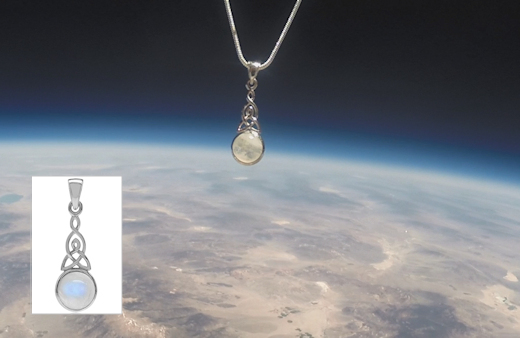
You can have it for $119.95. The students are selling these pendants to support their cosmic ray ballooning program. Each one comes with a greeting card showing the item in flight and telling the story of its journey to the edge of space. Sales support the Earth to Sky Calculus cosmic ray ballooning program and hands-on STEM research.
Far Out Gifts: Earth to Sky Store
All sales support hands-on STEM education