LUNAR ECLIPSE AND MARTIAN CONJUNCTION: Friday, July 27th, is a big night for astronomy. Mars will be at opposition--directly opposite the sun and making a 15-year close approach to Earth. Also, Mars and the Moon will be in conjunction--less than 10 degrees apart. And best of all, the Moon will pass through the shadow of Earth, producing the longest lunar eclipse in a century--visible everywhere except North America. What a night! Tune into live webcasts from Israel and Belgium.


FEAR AND PANIC: The two moons of Mars, Phobos and Deimos (Greek for Fear and Panic), are easy to overlook. They're tiny, less than 22 km wide, dim and rarely seen through a telescope. Mars itself shines 242,000 times brighter than Phobos and 741,000 times brighter than Deimos. The two moons get lost in the glare. But with Mars on the verge of a 15-year close approach to Earth, the tiny moons are possible to photograph. Dzmitry Kananovich of Crete did it on July 23rd:

"During the current opposition of Mars, Phobos and Deimos are relatively easy targets," says Kananovich. "At least I captured them much easier than during my previous attempt in 2016. The animation demonstrates the orbital motion of Phobos and Deimos around the Red Planet. I used an 11-inch Celestron telescope to capture the images. Separately, I photographed Mars using R, G, B filters to get a non-overexposed color image, which was added afterwards."
As Mars approaches Earth this week, many rare and beautiful pictures of the Red Planet will be taken. Monitor our realtime Mars photo gallery for the latest:
SPRITES VS. THE MOON: Red sprites that leap up from thunderstorms are always brief and often dim. On July 21st they were bright enough to see through the glare of the waxing Moon. Martin Popek photographed the display from Nýdek in the Czech republic:

Sprites are an exotic form of upward-directed lightning, reaching from the tops of electrical storms all the way up to the edge of space. Because they emerge from the tops of storms, the best place to see sprites is from a distance where the camera can point over the edge of the thunderhead.
"I was about 200 km away from the storm," says Popek. "It was a porwerful Mesoscale Convective System across the border in Hungary."
Some researchers think that sprites are linked to cosmic rays. Subatomic particles from deep space strike the top of Earth's atmosphere, producing secondary electrons that trigger the upward bolts. Cosmic rays are now intensifying due to the decline of the solar cycle. More sprites, anyone?

INSIDE THE SHADOW OF THE MOON: Last August, during the Great American Solar Eclipse, the students of Earth to Sky Calculus launched 11 space weather balloons from the path of totality. Their mission: to photograph the Moon's shadow from the stratosphere. These rose quartz crystals went along for the ride:
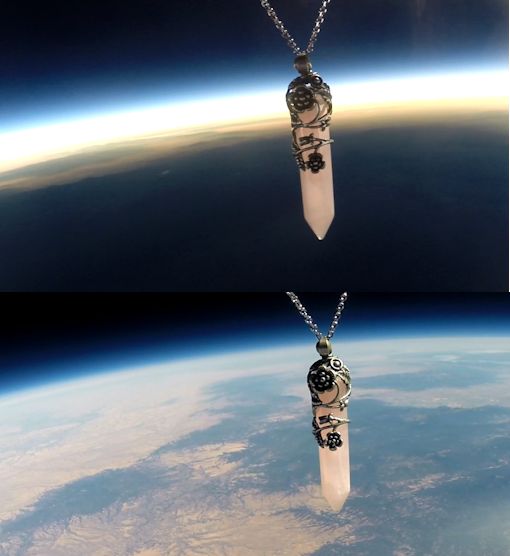
During the 2.5 hour flight, the pendants were wrapped in the Moon's shadow for more than two minutes, experiencing a spooky darkness colder than -50 C.
We still have a few left, and you can have one for $169.95. Each crystal pendant comes with a unique gift card showing the jewelry passing through the Moon's shadow and floating at the top of Earth's atmosphere. The interior of the card tells the story of the flight and confirms that this gift has been to the edge of space and back again.
Far Out Gifts: Earth to Sky Store
All sales support hands-on STEM education
Realtime Noctilucent Cloud Photo Gallery