SOLAR MINIMUM DEEPENS: The sun has been without sunspots for 30 of the past 31 days. To find a similar stretch of blanks suns, you have to go back to 2009 when the sun was experiencing the deepest solar minimum in a century. Clearly, solar minimum has returned, bringing extra cosmic rays, long-lasting holes in the sun's atmosphere, and strangely pink auroras. Free: Aurora alerts.
LATE-SEASON SURGE IN NOCTILUCENT CLOUDS: Noctilucent clouds (NLCs) are behaving strangely. Normally, NLCs begin to dim in late July, then fade away completely as August unfolds. It is their seasonal pattern. This year, though, the night-shining clouds are surging as July comes to an end. "We had a mind-blowing display of noctilucent clouds display on July 26th," reports Kairo Kiitsak, who sends this picture from Simuna, Estonia:
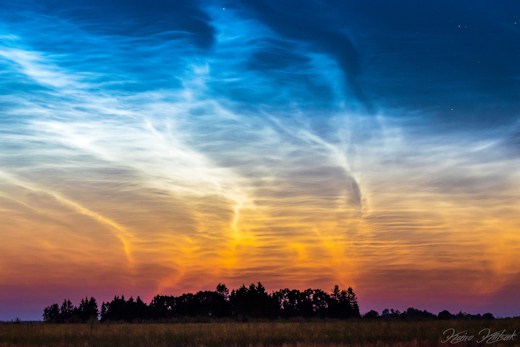
"The rippling structure of the clouds was amazing," says Kiitsak. "In all, the display lasted for full three hours."
The clouds rippled as far south as Poland, where Marek Nikodem saw them before sunrise on July 28th:
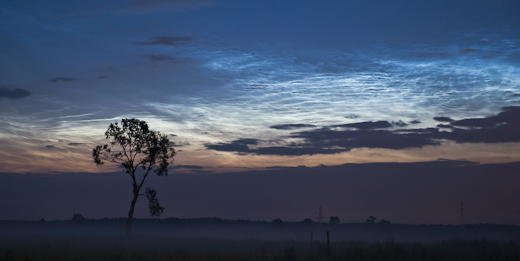
"It was quite a surprise," says Nikodem. "As a rule, the NLC season in Poland ends around July 25. But not this year, today in the morning there was a bright and really beautiful display."
Noctilucent clouds form when summertime wisps of water vapor rise to the top of the atmosphere and wrap themselves around specks of meteor smoke. Mesospheric winds assemble the resulting ice crystals into NLCs. In 2017 a heat wave in the mesosphere melted those crystals, causing a brief "noctilucent blackout." Could something similar, but opposite, be happening now? Perhaps a cold spell in the mesosphere is extending the season. Another possibility is the solar cycle. Previous studies have shown that NLCs sometimes intensify during solar minimum. Solar minimum conditions are in effect now as the sun has been without spots for 30 of the past 31 days.
Stay tuned for updates.
Realtime Noctilucent Cloud Photo Gallery
TOTAL ECLIPSE OF THE MOON: On July 27, 2018, the Moon passed through the shadow of our planet, producing the longest lunar eclipse of the century. The face of the Moon turned red for 1 hour and 43 minutes--an event visible from every continent except North America. Anthony Ayiomamitis photographed the eclipse from Athens, Greece:
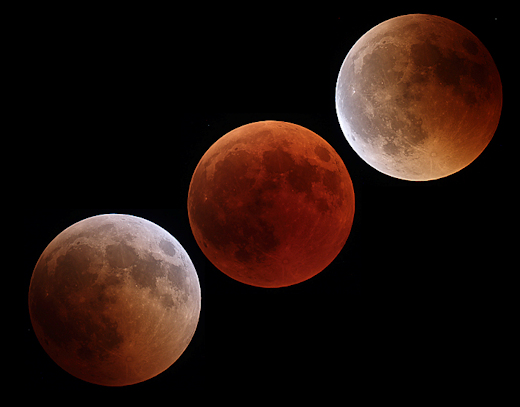
"We were very fortunate to have pristine skies for this evenings longest total lunar eclipse of the 21st century," says Ayiomamitis.
In the composite image, above, Anthony sandwiched an image of the all-red totally eclipsed Moon between images of the Moon just before and after totality. Note the fringes of pale blue in those outer Moons.
The blue color is caused by ozone. Atmospheric scientist Richard Keen of the University of Colorado explains: "Most of the light illuminating the Moon passes through the stratosphere, and is reddened by scattering. However, light passing through the upper stratosphere penetrates the ozone layer, which absorbs red light and actually makes the passing light ray bluer." This creates a turquoise-blue border around the red.
For more shots of the eclipse, and its "ozone fringe," browse the photo gallery:
Realtime Lunar Eclipse Photo Gallery
FAR-OUT GIFT: Nothing says "I Love You" like a heart-shaped pendant from the edge of space. On March 17, 2018, the students of Earth to Sky Calculus flew an array of cosmic ray sensors to the stratosphere onboard a giant helium balloon. This pendant went along for the ride:
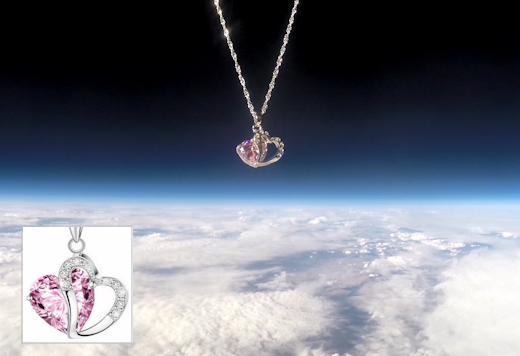
You can have it for $99.95. The students are selling these pendants as a fund-raiser for their cosmic ray monitoring program. Each pendant comes with a greeting card showing the jewelry in flight and telling the story of its journey to the stratosphere and back again.
Far Out Gifts: Earth to Sky Store
All sales support hands-on STEM education