SOLAR MINIMUM DEEPENS: The sun has been without sunspots for 33 of the past 34 days. To find a similar stretch of blank suns, you have to go back to 2009 when the sun was experiencing the deepest solar minimum in a century. Solar minimum has returned, bringing extra cosmic rays, long-lasting holes in the sun's atmosphere, and strangely pink auroras. Free: Aurora alerts.
ATMOSPHERIC RADIATION UPDATE: As the sunspot cycle declines, we expect cosmic rays to increase. Is this actually happening? The answer is "yes." Spaceweather.com and the students of Earth to Sky Calculus have been monitoring cosmic radiation in the atmosphere with frequent high-altitude balloon flights over California. Here are the latest results, current as of July 2018:

Above: X-ray/gamma-ray dose rates in the stratosphere over California. Energy range: 10 keV - 20 MeV
The data show radiation levels intensifying with an approximately 18% increase in monthly averages since March 2015. This comes as sunspot counts have dipped to a ~10-year low in June and July 2018.
Cosmic rays are the subatomic debris of dying stars, accelerated to nearly light speed by supernova explosions. They travel across the galaxy and approach Earth from all directions, peppering our planet 24/7. When cosmic rays crash into Earth's atmosphere, they produce a spray of secondary particles and photons that is most intense at the entrance to the stratosphere. This secondary spray is what we measure.
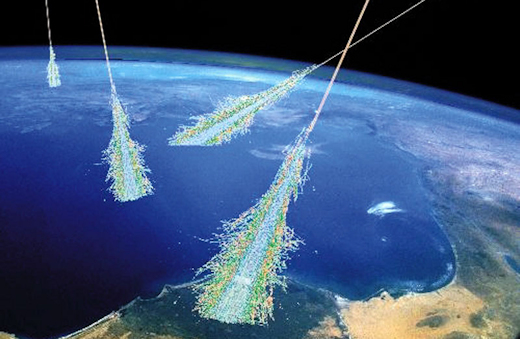
Above: An artist's rendering of secondary cosmic rays. [more]
Sunspots and cosmic rays have a yin-yang relationship. At the peak of the sunspot cycle, strong solar magnetic fields and solar wind hold many cosmic rays at bay. During solar minimum, however, the sun's magnetic field weakens and the outward pressure of the solar wind decreases. This allows more cosmic rays from deep space to penetrate the inner solar system and our planet's atmosphere.
The increase is widespread. Every place in the USA where we have launched multiple balloons exhibits the same pattern. There are upward trends from coast to coast:

The plot, above, shows more than 150 stratospheric radiation measurements we have made using balloons flown over the continental USA. Because California is our home base, it is more densely sampled than other states. Adding additional points outside California remains a key goal of the monitoring program.
How do cosmic rays affect us? Cosmic rays penetrate commercial airlines, dosing passengers and flight crews so much that pilots are classified as occupational radiation workers by the International Commission on Radiological Protection (ICRP). According to a recent study from researchers at the Harvard School of Public Health, flight attendants face an elevated risk of cancer compared to members of the general population. The investigators listed cosmic rays among several risk factors. Weather and climate may also be affected, with some research linking cosmic rays to to the formation of clouds and lightning.
In August-December 2018 we will conduct a new campaign of coordinated balloon launches from the USA (including sites in California, Washington, Kansas, Oregon, and Maine), Chile, and New Zealand to further probe the evolving cosmic ray situation. As solar activity declines we expect to find increasing radiation around the globe. Stay tuned for updates.
Realtime Space Weather Photo Gallery
FLY ME TO THE MOONSTONE: Are you looking for a far-out gift? Nothing says "I love you" like a moonstone from the edge of space. On June 12th, the students of Earth to Sky Calculus flew this moonstone wrapped in a sterling silver Celtic love knot 34.1 km (111,877 feet) above Earth's surface:
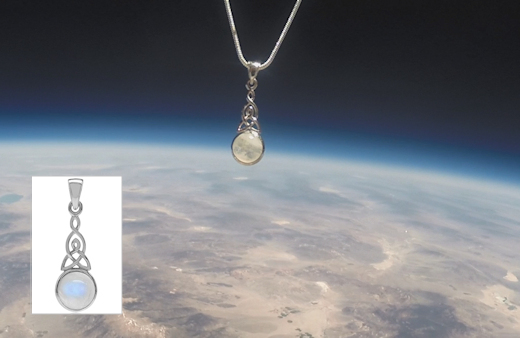
You can have it for $119.95. The students are selling these pendants to support their cosmic ray ballooning program. Each one comes with a greeting card showing the item in flight and telling the story of its journey to the edge of space. Sales support the Earth to Sky Calculus cosmic ray ballooning program and hands-on STEM research.
Far Out Gifts: Earth to Sky Store
All sales support hands-on STEM education
Realtime Lunar Eclipse Photo Gallery