A NEW SUNSPOT: A new sunspot is growing in the sun's southeastern quadrant, breaking a string of 10 consecutive spotless days. It is small and still unnumbered. Nevertheless, the emerging dark core merits attention because sunspots are so scarce during this minimum phase of the solar cycle. Free: Aurora alerts.

NOCTILUCENT CLOUDS STILL GOING STRONG: Usually, August 1st is the beginning of the end for noctilucent clouds in the northern hemisphere. Weather conditions at the top of Earth's atmosphere shift in August, making it more difficult for summertime wisps of water vapor to crystallize around specks of meteor smoke. As August begins in 2018, however, noctilucent clouds are still going strong. Just this morning, Vesa Vauhkonen photographed a bright display over Rautalampi, Finland:

"Night-shining clouds over the lake of Konnevesi were very beautiful--the best ones I've seen in many years," says Vauhkonen.
A similar display appeared over the Talkeetna Mountains of Alaska. "They were the best noctilucent clouds I've ever seen, extremely bright," says eyewitness Tempy Larew.
What's happening? Previous studies have shown that NLCs sometimes intensify during solar minimum. The idea is that extreme UV rays from the sun dim during solar minimum, reducing a form of radiation that can split apart water molecules. More water in the mesosphere means more noctilucent clouds. Solar minimum conditions are in effect now as the sun has been without spots for 34 of the past 36 days. Perhaps noctilucent clouds are thriving as a result.
Realtime Noctilucent Cloud Photo Gallery
IRIDESCENT SPACE PYRAMID: Spaceweather.com and the students of Earth to Sky Calculus have been traveling around the world launching cosmic ray balloons to map Earth's radiation field. This runs up a big helium bill. To help pay it, we sent this iridescent crystal pyramid to the stratosphere:
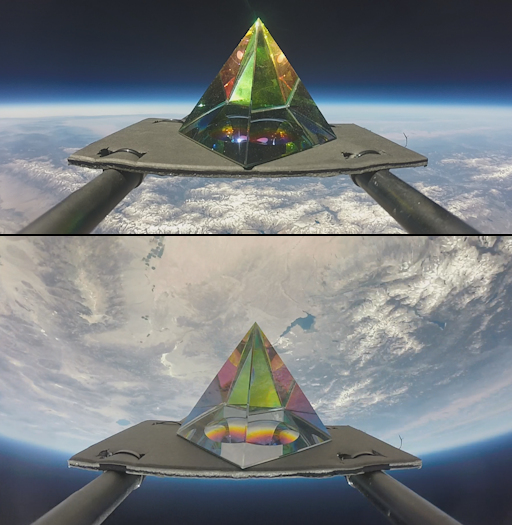
You can have it for $149.95. The students are selling "space pyramids" to fund the Earth to Sky ballooning program. Each one comes with a greeting card showing the pyramid in flight and telling the story of its journey to the edge of space. All sales support hands-on STEM research.
Far Out Gifts: Earth to Sky Store
All sales support hands-on STEM education
OZONE FRINGE ON THE MOON: When you think of a lunar eclipse, the color that comes to mind is red. The core of Earth's shadow is reddened by atmospheric scattering, and when that shadow falls across the Moon, the lunar landscape turns as red as a sunset. Yet some observers of last Friday's lunar eclipse saw another color--blue:

"Just before Earth's shadow swallowed the Moon, the edge of the lunar disk turned vivid blue," reports Peter Lowenstein of Mutare, Zimbabwe. "I created this animation of the phenomenon using 21 still photographs taken over a 10-minute period."
Another picture he took later in the eclipse shows how the inner red shadow has a pale blue circumference:

The source of the blue color is ozone. Eclipse researcher Dr. Richard Keen, professor emeritus at the University of Colorado, explains: "Most of the light illuminating the moon passes through the stratosphere, and is reddened by scattering. However, light passing through the upper stratosphere penetrates the ozone layer, which absorbs red light and actually makes the passing light ray bluer." This can be seen, he says, as a turquoise fringe around the red.
Other photographers spotted the blue fringe as well, including Shahrin Ahmad of Malaysia; Majed Abu-Zahara of Saudi Arabia; and Nunzio Micale of Italy. More examples may be found in the Lunar Eclipse Photo Gallery:
Realtime Lunar Eclipse Photo Gallery