A BRIGHT METEOR OVER GREENLAND: Some media outlets are reporting a meteor strike near the USA's Thule Air Base in Greenland on July 25th. Why hasn't the US Air Force said anything about it? Probably because the impactor was a fairly routine space rock--not a nuclear missile. "Bad Astronomer" Phil Plait lays out the facts in this excellent article.
DYING COMET PANSTARRS: Comet PanSTARRS (C/2017 S3) was supposed to become a naked-eye object in August as it swooped past the sun closer than Mercury. It's not going to happen. Instead of brightening the icy comet, fierce solar heat is destroying it. Michael Jaeger sends this video, recorded August 1st, from Jauerling, Austria:

"The comet is just a remnant of its former self," says Jaeger. "It is fading, becoming more diffuse and elongated each time I look."
Comet PanSTARRS (C/2017 S3) was discovered on Sept. 23, 2017, by astronomers using the PanSTARRS telescope on the Haleakalā volcano in Maui. At the time, it was falling toward the sun from the Oort cloud, a vast reservoir of fresh comets in the distant outer solar system. The approaching comet appeared to be packed with volatile ices that would react flamboyantly to solar heat--ultimately creating a naked-eye display.
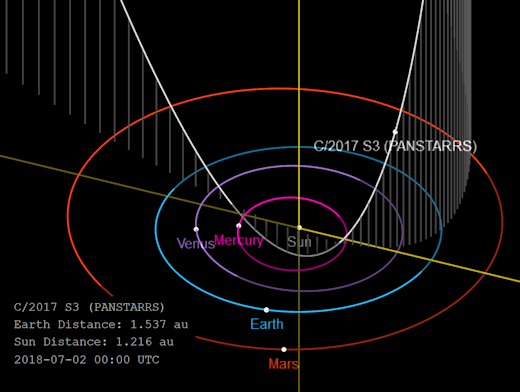
Click to launch an interactive 3D visualization of the comet's orbit from JPL
However, all of the flamboyant action occurred last month while Comet PanSTARRS (C/2017 S3) was still outside the orbit of Earth. The comet exploded twice in July, each time surging in brightness without crossing the threshold of naked-eye visibility. Exploding twice takes a toll on a comet, and now it is falling apart.
"Comet PanSTARRS (C/2017 S3) is now a 9th magnitude object,"says Jaeger. That means it is still a good target for backyard telescopes--but not for long. The comet's close approach to the sun is on August 16th, and it may not survive the encounter. Stay tuned.
CRYSTAL EARTH GLOBE AT THE EDGE OF SPACE: On August 2, 2018, art met science 101,534 feet above Earth's surface. Here's what happened:

The students of Earth to Sky Calculus flew a cosmic ray balloon to the stratosphere, and this crystal globe went along for the ride. The young scientists wanted to see what Earth looked like when viewed through the spherical lens ... of Earth. Answer: very cool.
You can have this globe for $149.95. The students are selling them to support their high-altitude balloon program. Each one comes with a greeting card showing the crystal sphere in flight and telling the story of its journey to the edge of space. All sales support the Earth to Sky Calculus cosmic ray ballooning program and hands-on STEM research.
Far Out Gifts: Earth to Sky Store
All sales support hands-on STEM education
Realtime Noctilucent Cloud Photo Gallery