A SOLAR WIND STREAM APPROACHES: Minor geomagnetic unrest is possible on Aug. 7th when Earth passes through a stream of fast-moving solar wind. The gaseous material is flowing from a small hole in the sun's atmosphere. Wind speeds could top 500 km/s (1.1 million mph) according to NASA's STEREO-A spacecraft, which encountered the stream before Earth did. Free: Aurora alerts.
THE PERSEID METEOR SHOWER IS UNDERWAY: You know a meteor shower is going to be good when it produces dozens of fireballs a whole week before the shower peaks. Welcome to the Perseids. The best meteor shower of the year peaks Aug. 11th-13th when Earth passes through a stream of debris from giant comet 109P/Swift-Tuttle. NASA's network of all-sky meteor cameras is already picking up strong activity over the USA, counting 66 Perseid fireballs during the three day period Aug. 4th-6th. Here's one of them, recorded Sunday morning above the Marshall Space Flight Center in Huntsville, Alabama:

The fireball was nearly as bright as the Moon and the video shows it exploding just before it vanished.
The Perseid meteor shower is always good, but this year it is extra-good. The Moon will be New during the shower's peak, providing a dark backdrop for as many as 100 meteors per hour. The best time to look is during the dark hours before sunrise on Sunday, August 12th, and again on Monday, August 13th. At those times, the shower's radiant will be high in the sky, spewing meteors in all directions:
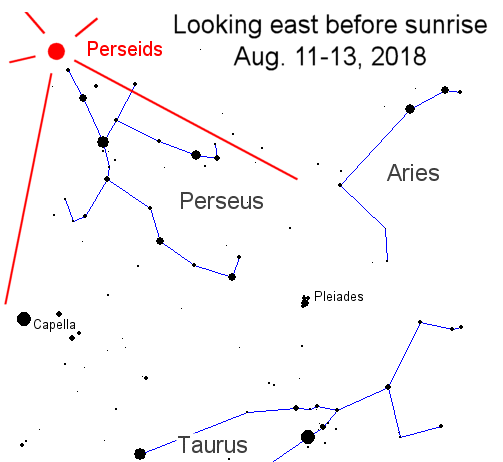
To see the greatest number of meteors, get away from city lights. Dress warmly, lie down on a blanket in a safe, dark place, and look up. Perseids can appear in any part of the sky, although all of their tails will point back toward the radiant in the constellation Perseus.
Fun tip: Try looking for Perseids around 10 pm local time when the radiant is hugging the northern horizon. At that time, Perseids skim the top of the atmosphere, producing long colorful fireballs known as "Earthgrazers." You won't see many, but even one can make your day. Enjoy the show!
Realtime Space Weather Photo Gallery
FAR-OUT OPTICS EXPERIMENT: Last week, the students of Earth to Sky Calculus flew a cosmic ray balloon to the stratosphere. A crystal globe went along for the ride. The young scientists wanted to see what Earth looked like when viewed through the spherical lens ... of Earth. Answer: very cool. Play the video to see for yourself:
You can have this globe for $149.95. The students are selling them to support their high-altitude balloon program. Each one comes with a greeting card showing the crystal sphere in flight and telling the story of its journey to the edge of space. All sales support the Earth to Sky Calculus cosmic ray ballooning program and hands-on STEM research.
Far Out Gifts: Earth to Sky Store
All sales support hands-on STEM education