SOLAR MINIMUM CONDITIONS ARE IN EFFECT: The sun has been without sunspots for 38 of the past 41 days. To find a similar stretch of blank suns, you have to go back to 2009 when the sun was experiencing the deepest solar minimum in a century. Solar minimum has returned, bringing extra cosmic rays, long-lasting holes in the sun's atmosphere, and strangely pink auroras. Free: Aurora alerts.
PERSEID METEOR SHOWER INTENSIFIES: The Perseid meteor shower is underway as Earth enters a stream of debris from giant comet 109P/Swift-Tuttle. International observers are reporting as many as 18 meteors per hour from dark-sky sites--rates that could increase 5-fold by the time the shower peaks this weekend. On August 6th, Catalin Tapardel caught this early Perseid crossing a satellite over Kakwa, Alberta, Canada:

"I went out in order to get some shots of the Milky Way and I realized there were quite a few Perseids, too," he says. "As I was shooting, I realized moving my flashlight around the bushes that a lynx was staring at me! Not a big cat, but scary to watch it, staying still as a sphinx, looking at me…."
Wildcats are something to think about when you consider these Perseid observing tips: Number one, get away from city lights. Rural areas are the best places to see a meteor shower. Dress warmly, lie down on a blanket in a safe, dark place, and look up. Perseids can appear in any part of the sky, although all of their tails will point back toward the radiant in the constellation Perseus.
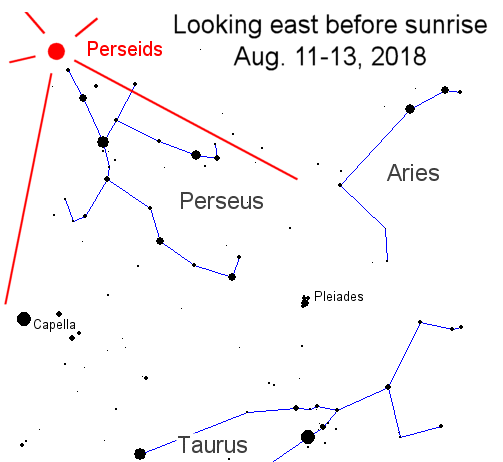
Earth is just in the outskirts of the comet's debris stream now. Activity will increase as our planet passes through the core of the stream this weekend. The best time to look is during the dark hours before sunrise on Sunday, August 12th, and again on Monday, August 13th. At those times, the shower's radiant will be high in the sky, spewing meteors in all directions.
Fun tip: Try looking for Perseids around 10 pm local time when the radiant is hugging the northern horizon. At that time, Perseids skim the top of the atmosphere, producing long colorful fireballs known as "Earthgrazers." You won't see many, but even one can make your day. Enjoy the show!
Realtime Space Weather Photo Gallery
FAR-OUT OPTICS EXPERIMENT: Last week, the students of Earth to Sky Calculus flew a cosmic ray balloon to the stratosphere. A crystal globe went along for the ride. The young scientists wanted to see what Earth looked like when viewed through the spherical lens ... of Earth. Answer: very cool. Play the video to see for yourself:
You can have this globe for $149.95. The students are selling them to support their high-altitude balloon program. Each one comes with a greeting card showing the crystal sphere in flight and telling the story of its journey to the edge of space. All sales support the Earth to Sky Calculus cosmic ray ballooning program and hands-on STEM research.
Far Out Gifts: Earth to Sky Store
All sales support hands-on STEM education