SOLAR ECLIPSE THIS WEEKEND: The Moon is about to take a bite out of the sun. On Saturday, August 11th, there will be a partial solar eclipse visible from locations around the Arctic Circle and across much of Asia. During the 3+ hour event, as much as 73% of the solar disk will be covered. Selected cities in the eclipse zone include Moscow (2.1% coverage), Oslo (4.8%), Raykjavik (20%), Tromso (29%), and Seoul (35%). Get ready: observing tips, movie, photo gallery
A PERSEID IN THE PLEIADES: The Perseid meteor shower is intensifying as Earth moves deeper into the debris stream of giant comet 109P/Swift-Tuttle. Observers with the International Meteor Organization are reporting 20 to 30 meteors per hour from dark sky sites. "Last night, I saw a lucky Perseid strike right through the heart of the Pleiades," says Pierre Girard of Milton Keynes, UK:

The rainbow-colored meteor was about 3rd magnitude--that is, similar in brightness to the stars of the Seven Sisters. Some Perseids are much brighter than that. On Aug. 9th, NASA's network of all-sky meteor cameras recorded 15 Perseid fireballs over the USA. Fireballs are meteors more luminous than Venus that can even cast shadows on a very dark night.
The Perseid meteor shower is expected to peak this weekend with 100 or more meteors per hour. The best time to look is during the dark hours before sunrise on Sunday, August 12th, and again on Monday, August 13th. At those times, the shower's radiant will be high in the sky, spewing meteors in all directions. [sky map]

Realtime Space Weather Photo Gallery
NOCTILUCENT CLOUDS STILL GOING STRONG: Something unusual is happening in Earth's upper atmosphere. Normally in August, summertime noctilucent clouds (NLCs) begin to fade as weather conditions in the mesosphere disfavor the formation of meteor-seeded ice crystals. This August, however, NLCs are going strong. Just this morning, Gordon Mackie witnessed a bright display over Caithness, Scotland:

"It was good to see NLCs shining brightly above Thurso Bay before their observing season comes to a close for this year," says Mackie. "They were so mesmerising I forgot to keep a lookout for Perseid meteors."
So far in August 2018, noctilucent clouds are being reported to Spaceweather.com four times as often as during the same period in 2017. What's happening up there? It might be the solar cycle at work. Previous studies have shown that NLCs sometimes intensify during solar minimum. During solar minimum, the sun's extreme UV output decreases. This has two effects: (1) the upper atmosphere cools and (2) the upper atmosphere keeps more of its water molecules, which are normally split apart by UV rays. More water + less warmth = more icy noctilucent clouds. If this is indeed what's happening, more NLCs may be in the offing as solar minimum continues to deepen in August 2018.
Realtime Noctilucent Cloud Photo Gallery
FLY ME TO THE MOONSTONE: Are you looking for a far-out gift? Nothing says "I love you" like a moonstone from the edge of space. On Jan 27th, the students of Earth to Sky Calculus flew this moonstone wrapped in a hand-crafted sterling silver Celtic love knot 35.1 km (115,158 feet) above Earth's surface:
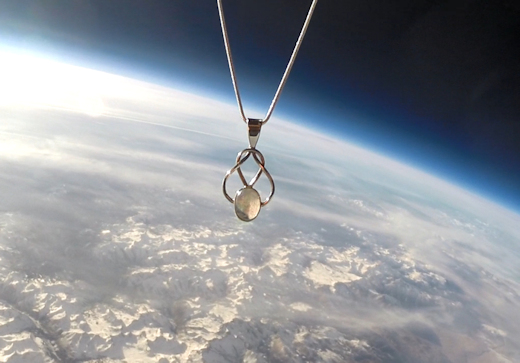
You can have it for $179.95. The students are selling these pendants to support their cosmic ray ballooning program. Each one comes with a greeting card showing the item in flight and telling the story of its journey to the edge of space. All sales support the Earth to Sky Calculus cosmic ray ballooning program and hands-on STEM research.
Far Out Gifts: Earth to Sky Store
All sales support hands-on STEM education
Realtime Space Weather Photo Gallery