THE PERSEID METEOR SHOWER IS INTENSIFYING: Perseid meteor rates are swiftly climbing as Earth moves deeper into the debris zone of comet 109P/Swift-Tuttle. Forecasters expect as many as 100 meteors per hour when the shower peaks on Aug. 12th and 13th. The sky is getting so busy that astrophotographers are having trouble keeping meteors out of their exposures:
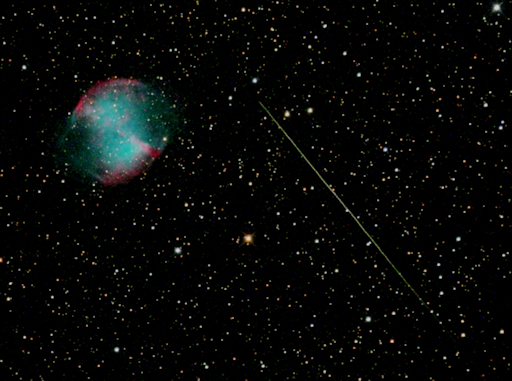
"On Saturday night, Aug 10th, a Perseid meteor streaked by my framed image of M27, the Dumbbell Nebula," says photographer Ric Babcock of San Juan Bautista, CA.
The Perseid meteor shower is always good, but this year it is extra-good. The Moon is nearly New during the shower's peak, providing a velvety-dark backdrop for the display. The best time to look is during the hours before sunrise on Sunday, August 12th, and again on Monday, August 13th. At those times, the shower's radiant will be high in the sky, spewing meteors in all directions:
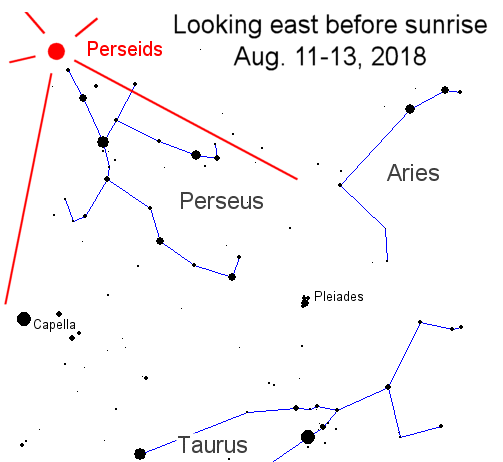
For best results, get away from city lights. Dress warmly, lie down on a blanket in a safe, dark place, and look up. Perseids can appear in any part of the sky, although all of their tails will point back toward the radiant in the constellation Perseus.
ARCTIC AURORA SEASON BEGINS: "This is it! The new aurora season is here," reports Thomas Kast of Oulu, Finland, near the Arctic Circle. "On Aug. 12th, I went to a little marina near Oulu to catch some Perseids and noctilucent clouds (NLCs). Suddenly this weak green arc appeared behind the NLCs."
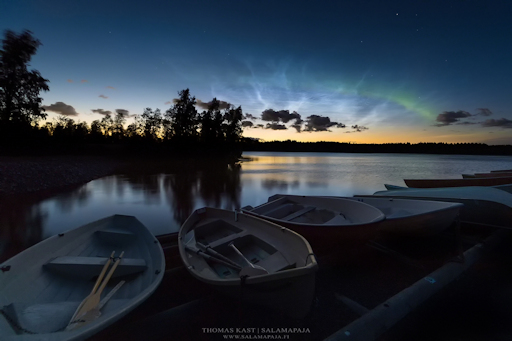
"I'm so thrilled to have seen auroras finally again after four months of summer sunlight," he says. "It's like the first time all over again. Pure magic."
As aurora season begins, noctilucent cloud season refuses to end. Normally in August, summertime noctilucent clouds (NLCs) begin to fade as weather conditions in the mesosphere disfavor the formation of meteor-seeded ice crystals. This August, however, NLCs are going strong, with the clouds being reported to Spaceweather.com four times as often as during the same period in 2017. Previous studies have shown that NLCs sometimes intensify during solar minimum. Perhaps that is what is happening now. If so, electric-blue and aurora-green may be mixing again in the nights ahead. Stay tuned.
FLY ME TO THE MOONSTONE: Are you looking for a far-out gift? Nothing says "I love you" like a moonstone from the edge of space. On Jan 27th, the students of Earth to Sky Calculus flew this moonstone wrapped in a hand-crafted sterling silver Celtic love knot 35.1 km (115,158 feet) above Earth's surface:
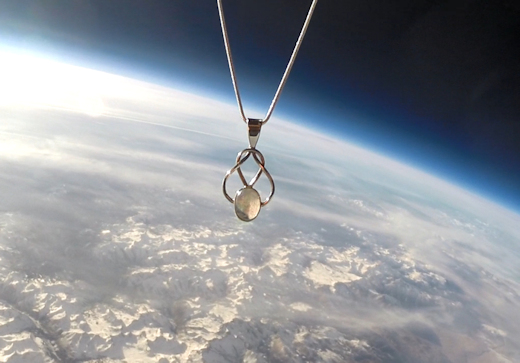
You can have it for $179.95. The students are selling these pendants to support their cosmic ray ballooning program. Each one comes with a greeting card showing the item in flight and telling the story of its journey to the edge of space. All sales support the Earth to Sky Calculus cosmic ray ballooning program and hands-on STEM research.
Far Out Gifts: Earth to Sky Store
All sales support hands-on STEM education
Realtime Space Weather Photo Gallery