NEW SUNSPOT: Breaking a string of 11 spotless days, a new sunspot group is growing in the sun's southern hemisphere. So far the emerging dark cores are small and quiet, not crackling with flares. This is typical of solar minimum sunspots. Free: Solar flare alerts.

GREAT PERSEIDS: The 2018 Perseid meteor shower was one of the best in years. The shower peaked on August 12-13 with many obserbers counting more than 100 meteors per hour. The New Moon coincided with the shower's peak, providing a dark backdrop for the flurry of debris from parent comet 109P/Swift-Tuttle. Highlights include this fireball photographed by Petr Horálek of Slovakia:

"The flash from this extremely bright fireball on Aug. 12th surprised dozens of observers in and around the Kolonica Observatory," says Horálek. "It was so bright, the landscape lit up as if under a crescent Moon. The debris trail (inset) was visible for more than one hour after the fireball appeared in the sky. What a great Perseids peak this year!"
SOLAR WIND, INCOMING: A long, narrow hole has opened in the sun's atmosphere, and it is spewing high-speed solar wind into space. NASA's Solar Dynamics Observatory photographed the fissure on Aug. 13th pointing directly at Earth:

This is a "coronal hole"--a region where the sun's magnetic field opens up and allows gaseous material to escape. Solar wind emerging from the hole is expected to reach Earth on Aug. 16th and 17th.
The incoming stream of solar wind may be preceded by a CIR (co-rotating interaction region). CIRs are transition zones between slow- and fast-moving solar wind. They often contain shock-like density gradients and strong magnetic fields that do a good job sparking auroras. And because Arctic aurora season began just a few days ago, the aurora photo gallery may soon receive some new additions.
FLY ME TO THE MOONSTONE: Are you looking for a far-out gift? Nothing says "I love you" like a moonstone from the edge of space. On Jan 27th, the students of Earth to Sky Calculus flew this moonstone wrapped in a hand-crafted sterling silver Celtic love knot 35.1 km (115,158 feet) above Earth's surface:
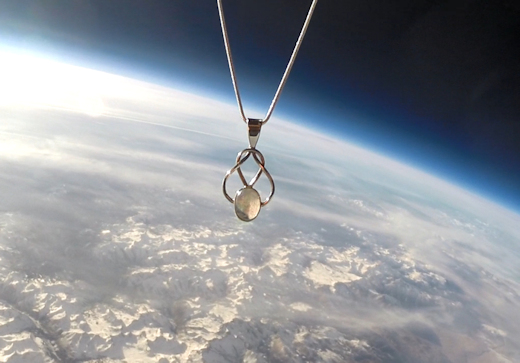
You can have it for $179.95. The students are selling these pendants to support their cosmic ray ballooning program. Each one comes with a greeting card showing the item in flight and telling the story of its journey to the edge of space. All sales support the Earth to Sky Calculus cosmic ray ballooning program and hands-on STEM research.
Far Out Gifts: Earth to Sky Store
All sales support hands-on STEM education
Realtime Space Weather Photo Gallery