SOLAR WIND SPARKS ARCTIC AURORAS: A stream of high-speed solar wind is buffeting Earth's magnetic field, sparking bright auroras around the Arctic Circle. The gaseous material is flowing from a wide hole in the sun's atmosphere--so wide that Earth could remain inside the stream for days to come. NOAA forecasters estimate 50% chance of polar geomagnetic unrest on Aug.21st. Free: Aurora Alerts.
STEVE IS NOT AN AURORA: A new type of aurora nicknamed "STEVE" may not be an aurora at all, according to a new paper published August 20th in the Geophysical Research Letters. A group of researchers combined satellite data with ground-based imagery of STEVE during a geomagnetic storm to investigate how STEVE is formed. "Our main conclusion is that STEVE is not an aurora," said Bea Gallardo-Lacourt, a space physicist at the University of Calgary in Canada and lead author of the new study.

STEVE, photographed by Greg Ash of Ely, Minnesota, on May 5, 2018 [more]
STEVE is a purple ribbon of light that amateur astronomers in Canada have been photographing for decades, belatedly catching the attention of the scientific community in 2016. It doesn't look exactly like an aurora, but it often appears alongside auroras during geomagnetic storms. Is it an aurora -- or not? That's what Gallardo-Lacourt's team wanted to find out.
Auroras appear when energetic particles from space rain down on Earth's atmosphere during geomagnetic storms. If STEVE is an aurora, they reasoned, it should form in much the same way. On March 28, 2008, STEVE appeared over eastern Canada just as NOAA's Polar Orbiting Environmental Satellite 17 (POES-17) passed overhead. The satellite, which can measure the rain of charged particles that causes auroras, went directly above the purple ribbon. Gallardo-Lacourt's team looked carefully at the old data and found ... no rain at all.
"Our results verify that this STEVE event is clearly distinct from the aurora borealis since it is characterized by the absence of particle precipitation," say the researchers. "Interestingly, its skyglow could be generated by a new and fundamentally different mechanism in Earth's ionosphere."
Another study has shown that STEVE appears most often in spring and fall. With the next equinox only a month away, new opportunities to study STEVE are just around the corner. Stay tuned and, meanwhile, read the original research here.
LASER-ETCHED MOON CUBE: On August 16, 2018, the students of Earth to Sky Calculus launched a cosmic ray balloon to the stratosphere. This unique laser-etched Moon cube went along for the ride, ascending to an altitude of 101,140 feet:
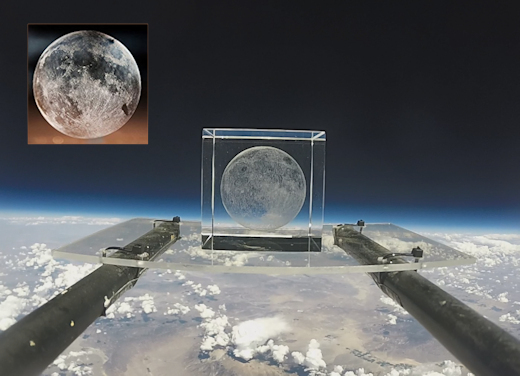
You can have it for $149.95. The students are selling these cubes as a fund-raiser for their cosmic ray ballooning program. It's an authentic representation of the Moon, with all of the craters, mountains and lava plains accurately portrayed.
Each Moon-cube comes with a unique gift card showing the item floating at the top of Earth's atmosphere. The interior of the card tells the story of the flight and confirms that this gift has been to the edge of space and back again.
Far Out Gifts: Earth to Sky Store
All sales support hands-on STEM education
Realtime Space Weather Photo Gallery
Realtime Noctilucent Cloud Photo Gallery