POSSIBLE CME IMPACT THIS WEEK: Earth's magnetic field could become unsettled on Aug. 24th or 25th when a slow-moving coronal mass ejection (CME) reaches our planet. There is much uncertainty about this CME. NASA and ESA satellites saw the solar storm cloud leave the sun on Aug. 21st, but they could not pinpoint its source on the solar disk, nor could they precisely determine its trajectory. If the CME does indeed hit Earth, it could spark auroras around the Arctic Circle. Free: Aurora Alerts.
A SPACESHIP IN FRONT OF THE SUN: Yesterday, the biggest sunspot on the sun was not a sunspot at all. It was a 450-ton spaceship with wings wider than a 747 jet--in other words, the International Space Station (ISS). Maximilian Teodorescu watched the ISS flit across the surface of the sun on August 22nd:

"I was very lucky to catch the split-second transit through a small opening in the clouds above Magurele, Romania," says Teodorescu. "The seeing was not great, but solar granulation is discernible as well as a few structural details in the station's silhouette. I knew when to look thanks to predictions from Calsky.com."
Now that the space station has passed by, the disk of the sun is almost entirely blank, interrupted only by the scattered dark cores of actual sunspot AR2719. AR2719 is small and quiet--typical of sunspots during solar minimum. Solar observers wishing to see some action may wish to check Calsky for future passes of the ISS.
Realtime Space Weather Photo Gallery
CHINESE SPACECRAFT FLIES BY BETELGEUSE: Earlier this year, the Chinese space station Tiangong-1 made headlines when it crashed into the south Pacific Ocean. Often forgotten is Tiangong-1's sister craft, Tiangong-2, which is still in orbit. Last night, Kevin Fetter of Brockville, Ontario, recorded the bus-sized spacecraft gliding by Betelgeuse, a red supergiant star in the constellation Orion:
Tiangong-2 is an unmanned space station, but it has not always been unoccupied. Chinese astronauts Jing Haipeng and Chen Dong boarded Tiangong-2 in Oct. 2016 and lived there for 30 days, conducting experiments in human physiology and practicing procedures for in-orbit rendezvous and docking.
Tiangong-2 was never intended to be a permanent station. Instead, the Chinese space agency is using it as practice for the Chinese large modular space station, which is reportedly planned for launch between 2019 and 2022.
In June 2018, Tiangong 2 maneuvered closer to Earth, apparently in preparation for deorbiting. However, it has since returned to its usual orbit. Readers, if you would like to see Tianging-2 for yourself, flyby predictions are available from Heavens Above.
FLY ME TO THE MOONSTONE: Are you looking for a far-out gift? Nothing says "I love you" like a moonstone from the edge of space. On Jan 27th, the students of Earth to Sky Calculus flew this moonstone wrapped in a hand-crafted sterling silver Celtic love knot 35.1 km (115,158 feet) above Earth's surface:
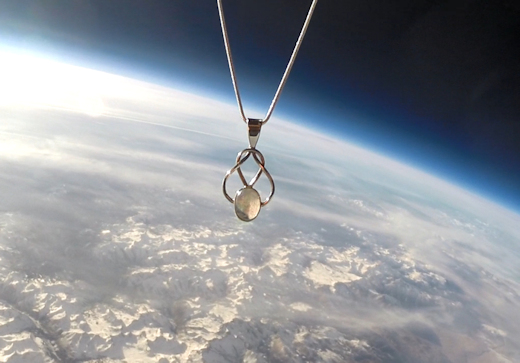
You can have it for $179.95. The students are selling these pendants to support their cosmic ray ballooning program. Each one comes with a greeting card showing the item in flight and telling the story of its journey to the edge of space. All sales support the Earth to Sky Calculus cosmic ray ballooning program and hands-on STEM research.
Far Out Gifts: Earth to Sky Store
All sales support hands-on STEM education
Realtime Noctilucent Cloud Photo Gallery