REVERSE POLARITY SUNSPOT: New sunspot AR2720 is not only large, but also strange. Its magnetic polarity is reversed. The North and South ends of its enormous magnetic field are backwards compared to the norm for sunspots in the current solar cycle, decaying Solar Cycle 24. What does this mean? AR2720 may be the first big sunspot of the next solar cycle, Solar Cycle 25, popping up now in the middle of solar minimum. Solar cycles always mix together at their boundaries. The slow transition between Solar Cycle 24 and Solar Cycle 25 appears to be underway.
SURPRISE GEOMAGNETIC STORM: Last night, a crack opened in Earth's magnetic field. Solar wind poured in to fuel a strong G3-class geomagnetic storm. John McKinnon photographed the storm's brilliant green glow from Four Mile Lake in Alberta, Canada:


"At 2 o'clock in the morning, the auroras were so bright I could see them through the glare of the full Moon," he says.
At the peak of the storm, Northern Lights spilled across the Canadian border into US states such as New York, Montana, Michigan, and Indiana. People in Alaska witnessed a fine display as well. At the same time, Southern Lights were photographed from several locations in New Zealand.
Forecasters did not see this coming. The stage was set for the storm when a minor CME arrived with little fanfare about 24 hours ago. First contact with the CME barely registered in solar wind data, and Earth's magnetic field was unperturbed. The action began only after Earth entered the CME's wake, where strong south-pointing magnetic fields opened a crack in our planet's magnetosphere. A surprise geomagnetic storm ensured.
The storm is subsiding, but it is not over. G1- and G2-class disturbances are still ringing the Arctic Circle. This means high-latitide sky watchers should remain alert for auroras after nightfall on Aug. 26-27. Free: Aurora Alerts.


FLY ME TO THE MOONSTONE: Are you looking for a far-out gift? Nothing says "I love you" like a moonstone from the edge of space. On Jan 27th, the students of Earth to Sky Calculus flew this moonstone wrapped in a hand-crafted sterling silver Celtic love knot 35.1 km (115,158 feet) above Earth's surface:
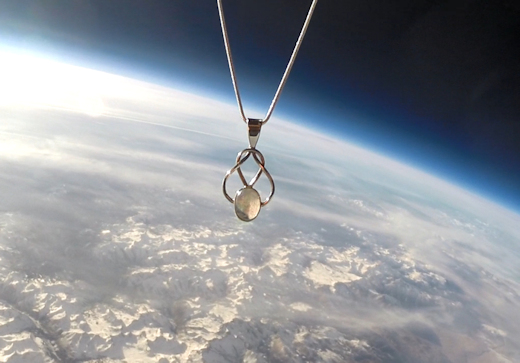
You can have it for $179.95. The students are selling these pendants to support their cosmic ray ballooning program. Each one comes with a greeting card showing the item in flight and telling the story of its journey to the edge of space. All sales support the Earth to Sky Calculus cosmic ray ballooning program and hands-on STEM research.
Far Out Gifts: Earth to Sky Store
All sales support hands-on STEM education
ATMOSPHERIC RADIATION UPDATE: Spaceweather.com and the students of Earth to Sky Calculus are in the middle of a cosmic ray ballooning campaign, visiting places we've been before to update our measurements of atmospheric radiation across the USA. On August 16th through 21st, we launched a series of balloons to the stratosphere from Bishop, CA; John Day, OR; and Wenatchee, WA. We found radiation levels increasing up and down the Pacific Coast. The latest data points are circled red:

Why is cosmic radiation increasing? Mainly, it's due to the solar cycle. As the sun plunges into a deep solar minimum, the sun's magnetic field is weakening. Solar wind pressures are declining as well. As a result of these changes, cosmic rays from deep space are finding it easier to penetrate the inner solar system. Surging cosmic rays hit the top of Earth's atmosphere, creating a downward spray of secondary particles and radiation that we detect using sensors on high-altitude balloons.
Our recent balloon launches from multiple US states as well as Sweden, Norway, Chile, Mexico and New Zealand confirm that cosmic rays are intensifying everywhere, but not by the same amount in all places. For instance, in the latest data we see that atmospheric radiation above Washington is almost 50% stronger than radiation above central California--a significant difference considering that the two launch sites are separated by only ~900 miles and 10 degrees of latitude. This shows that Earth's magnetic field is an uneven shield against incoming cosmic rays, protecting some places more than others.
Next week we'll be launching a cosmic ray balloon from Kansas and, soon thereafter, from Maine to extend our monitoring across the continental USA. Stay tuned.