SOLAR MINIMUM GEOMAGNETIC STORM: For most of 2018, the face of the sun has been blank, completely without sunspots. That didn't stop the sun from launching a coronal mass ejection (CME) toward Earth. On Aug. 20th, a reorganization of unstable magnetic fields in the sun's atmosphere hurled a cloud of plasma into space--no sunspot required. When that cloud (or "CME") reached Earth on Aug. 25-26, it sparked auroras all the way from the Arctic Circle to Indiana. Browse the aurora photo gallery to see the glow of a solar minimum geomagnetic storm. Free: Aurora Alerts.
ICE IN THE MESOSPHERE: As August comes to an end, summertime noctilucent clouds (NLCs) are supposed to be long gone. Normally, the mesosphere dries up in August, leaving no water to crystallize around meteor smoke. This August, however, is not normal. Only two nights ago, Adrien Mauduit saw the rippling forms of NLCs drifting over Silsand, Norway:
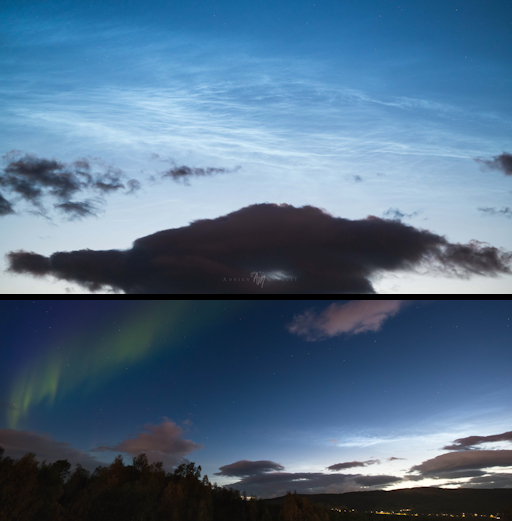
"It is impressive to see some ice still in the mesosphere at this time of year!" says Mauduit. "The display lasted for at least 3 hours, and it included a band of green auroras leftover from the previous night's surprisingly strong G3-class geomagnetic storm."
In Mauduit's photo, the dark forms hanging relatively close to the ground are normal tropospheric clouds. Noctilucent clouds glow high overhead, bathed in the light of the sun 83 km above Earth's surface.
Data from NASA's satellite-based Microwave Limb Sounder (MLS) instrument show that this August is indeed strange, with unusually high levels of water vapor in the mesosphere. Indeed, it has been the wettest August in the mesosphere for the past 11 years. Extra water has provided raw material for noctilucent clouds. Researchers still aren't sure why this is happening. Some possibilities are discussed in the recent Spaceweather.com news item, "A Mystery in the Mesosphere."
ANTI-CREPUSCULAR RAYS: The sun was setting yesterday in Golden, Missouri, when a spray of shadowy rays sprang up from the horizon. They looked like ordinary sunset rays except for one thing--"the sun was on the opposite side of the sky," says Zachary Blazek, who witnessed the display and photographed it from the verge of Table Rock Lake:
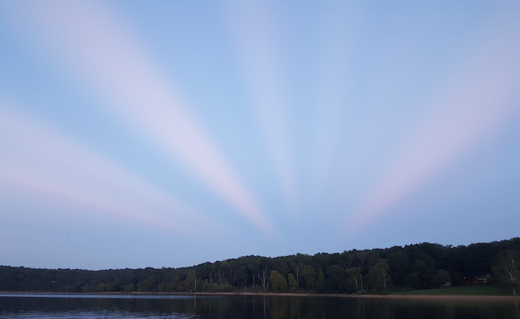
What were they? The answer: Anti-crepuscular rays.
Behind Blazek's back, the setting sun dipped behind some ragged clouds. The edges of those clouds cast shadows--immense tubes of darkness--that arced all the way across the sky to converge on the opposite horizon. Such shadows are called "anti-crepuscular rays."
Anti-crepuscular rays are not rare, but they are delicate and often go unnoticed as people look away from them, attracted by the colors of the setting sun on the opposite side of the sky. Readers, the next time you find your self tranfixed by the sunset, turn around. A beautiful display of anti-crepuscular rays might be waiting behind your back.
Realtime Space Weather Photo Gallery
IRIDESCENT SPACE PYRAMID: Spaceweather.com and the students of Earth to Sky Calculus have been traveling around the world launching cosmic ray balloons to map Earth's radiation field. This runs up a big helium bill. To help pay it, we sent this iridescent crystal pyramid to the stratosphere:
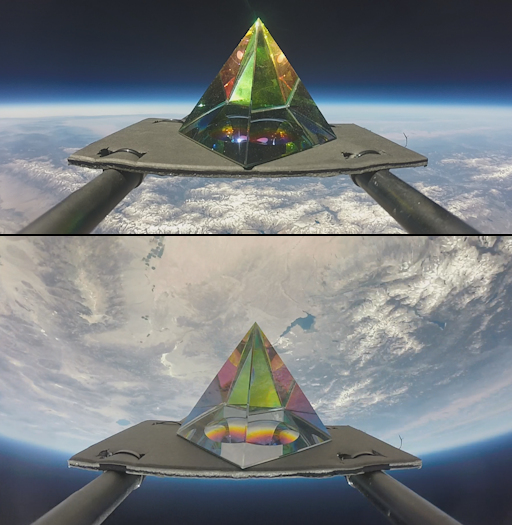
You can have it for $149.95. The students are selling this pyramid and several others like it to fund the Earth to Sky ballooning program. Each one comes with a greeting card showing the pyramid in flight and telling the story of its journey to the edge of space. All sales support hands-on STEM research.
Far Out Gifts: Earth to Sky Store
All sales support hands-on STEM education