WILL THE MARS ROVER PHONE HOME? An epic global dust storm on Mars is finally subsiding, raising hopes that Opportunity will phone home. The solar-powered rover has been silent since June 10th when its batteries failed due to sun-blocking dust. Now, however, skies are clearing in Perseverance Valley where Opportunity is located. Engineers at NASA's Jet Propulsion Laboratory believe the nearly 15-year-old rover could soon receive enough sunlight to automatically initiate recovery procedures. Stay tuned for updates.
AURORAS PHOTOGRAPHED FROM SPACE: When Northern Lights are as bright as city lights, you know that a strong geomagnetic storm must be underway. That's exactly what NOAA's Suomi NPP weather satellite saw on the night of August 26-27 when it orbited over North America. Swirls of aurora borealis overwhelmed the reflected glow of moonlit clouds and even rivaled some urban lights on the ground below:

This image comes from a low-light camera in the satellite's Visible Infrared Imaging Radiometer Suite (VIIRS) of sensors. It is designed to detect clouds, airglow, and light pollution. On this particular night, auroras stole the show.
The G3-class geomagnetic storm started on Aug. 25th when a coronal mass ejection (CME) hit Earth's magnetic field, opening a crack in our planet's magnetosphere. Solar wind poured in to fuel auroras seen from the Arctic Circle to Indiana. It was the strongest geomagnetic storm of the year so far, and one which forecasters did not expect. Free: Aurora Alerts.

RARE ICE HALOS OVER SYDNEY: Yesterday, something unusual happened in the sky above Sydney, Australia. The rising sun was preceded by a network of luminous curls, circles and arches. "It was a very rare display," says Adriano Massatani who photographed the sunrise:
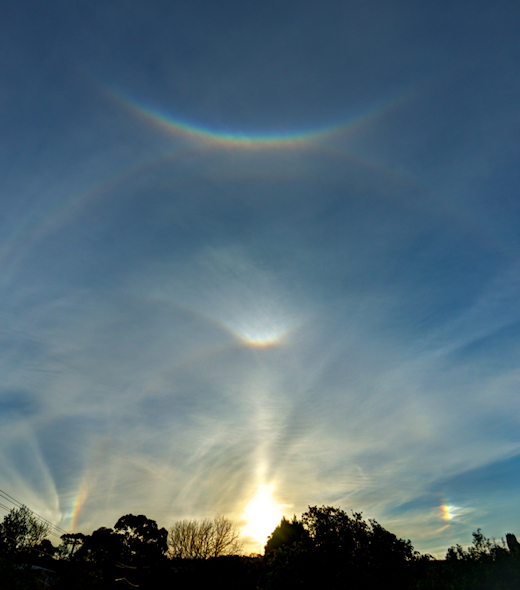
These luminous forms are called ice halos, because they caused by sunlight shining through icy crystals in cirrus clouds. Usually ice halos are simple, like a solitary pillar or an uncomplicated ring. In this case, however, a complex assortment of halos criss-crossed the sky. In Massatani's photo, we see a circumzenithal arc, an upper tangent arc, an upper suncave Parry arc, a 22-degree halo, a 46 degree halo, a supralateral arc, and a pair of sundogs.
That's not all. "Later, I also saw a complete parhelic circle--something I have been hoping to see for years," says Massatani.
The variety of halos Massatani witnessed was caused by a corresponding variety of ice crystals with rare gem-like perfection and unusually precise crystal-to-crystal alignment. What are the odds? No one knows. Certainly, though, it was a lucky day in Sydney.Realtime Space Weather Photo Gallery
IRIDESCENT SPACE PYRAMID: Spaceweather.com and the students of Earth to Sky Calculus have been traveling around the world launching cosmic ray balloons to map Earth's radiation field. This runs up a big helium bill. To help pay it, we sent this iridescent crystal pyramid to the stratosphere:
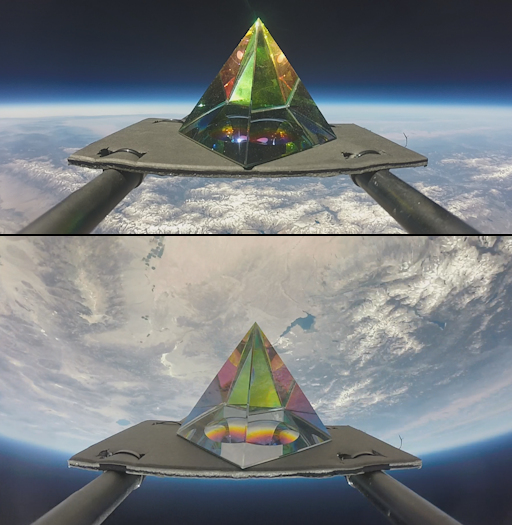
You can have it for $149.95. The students are selling this pyramid and several others like it to fund the Earth to Sky ballooning program. Each one comes with a greeting card showing the pyramid in flight and telling the story of its journey to the edge of space. All sales support hands-on STEM research.
Far Out Gifts: Earth to Sky Store
All sales support hands-on STEM education