SOLAR SECTOR BOUNDARY CROSSING: On Sept. 3rd, Earth will cross a fold in the heliospheric current sheet--a vast wavy structure in interplanetary space separating regions of opposite magnetic polarity. This is called a "solar sector boundary crossing," and it could trigger geomagnetic activity around Earth's poles. Arctic sky watchers should be alert for auroras when the crossing occurs. Free: Aurora Alerts.
159 YEARS AGO, A GEOMAGNETIC MEGA-STORM: Picture this: A billion-ton coronal mass ejection (CME) slams into Earth's magnetic field. Campers in the Rocky Mountains wake up in the middle of the night, thinking that the glow they see is sunrise. No, it's the Northern Lights. People in Cuba read their morning paper by the red illumination of aurora borealis. Earth is peppered by particles so energetic, they alter the chemistry of polar ice.
Hard to believe? It really happened--exactly 159 years ago. This map shows where auroras were sighted in the early hours of Sept. 2, 1859:

As the day unfolded, the gathering storm electrified telegraph lines, shocking technicians and setting their telegraph papers on fire. The "Victorian Internet" was knocked offline. Magnetometers around the world recorded strong disturbances in the planetary magnetic field for more than a week.
The cause of all this was an extraordinary solar flare witnessed the day before by British astronomer Richard Carrington. His sighting on Sept. 1, 1859, marked the discovery of solar flares and foreshadowed a new field of study: space weather. According to a NASA-funded study by the National Academy of Sciences, if a similar "Carrington Event" occurred today, it could cause substantial damage to society's high-tech infrastructure and require years for complete recovery.
Could it happen again? Almost certainly. In a paper published just a few months ago, researchers from the University of Birmingham used Extreme Value Theory to estimate the average time between "Carrington-like flares." Their best answer: ~100 years. In other words, we may be overdue for a really big storm. Read their original research here.
Realtime Space Weather Photo Gallery
FLY ME TO THE MOONSTONE: Are you looking for a far-out gift? Nothing says "I love you" like a moonstone from the edge of space. On June 12th, the students of Earth to Sky Calculus flew this moonstone wrapped in a sterling silver Celtic love knot 34.1 km (111,877 feet) above Earth's surface:
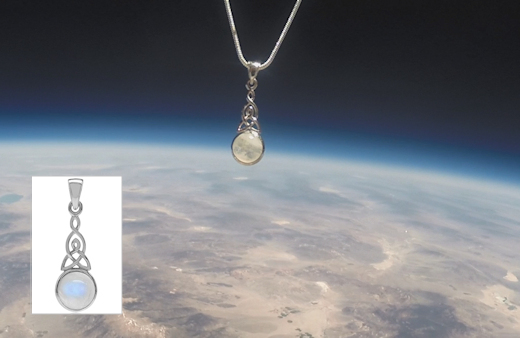
You can have it for $139.95. The students are selling these pendants to support their cosmic ray ballooning program. Each one comes with a greeting card showing the item in flight and telling the story of its journey to the edge of space. Sales support the Earth to Sky Calculus cosmic ray ballooning program and hands-on STEM research.
Far Out Gifts: Earth to Sky Store
All sales support hands-on STEM education
AUTUMN IS COMING: The northern autumnal equinox is now only 3 weeks away. Residents of Arctic Canada don't need a calendar to tell them that, however. The signs are in the sky. "Last night (Sept. 1st), auroras came out at dusk and kept dancing all night long," reports Yuichi Takasaka, who sends this picture from Yellowknife in the Northwest Territories:

Displays like these are a sign that autumn is coming.
Researchers have long known that, during weeks around equinoxes, cracks form in Earth's magnetosphere. Solar wind can pour through the gaps to fuel bright displays of Arctic lights. This is called the the "Russell-McPherron effect," named after the researchers who first explained it. A recent study covering 75 years of historical geomagnetic records shows that September-October are among the most geomagnetically active months of the year–a direct result of "equinox cracks." Free: Aurora Alerts.
