SOLAR WIND, INCOMING: A fast-moving stream of solar wind is approaching Earth. Estimated time of arrival: Sept. 7th. The gaseous material is flowing from a large hole in the sun's atmosphere. Arctic sky watchers should be alert for auroras later this week. Free: Aurora Alerts.

SPRITES FROM TROPICAL STORM GORDON: Later today, Tropical Storm Gordon is expected to reach the southeastern USA, possibly intensifying to hurricane strength just before it makes landfall. Unlike many hurricanes, which cross the Atlantic before reaching the states, Gordan formed nearby in the Caribbean. On Sept. 1st, Frankie Lucena of Puerto Rico trained his cameras on the tropical wave and caught sprites leaping up from the cloudtops:
"These sprites were captured over the tropical wave that later became Tropical Storm Gordon," says Lucena. "At the time, the wave was generating numerous lightning strikes per minute just west of Puerto Rico." In the video, red arrows show the location of his camera with respect to the growing storm, while the sprites are inset.
For years, Lucena has been observing sprites and their big cousins Gigantic Jets leap up from passing storms. Interestingly, he says, the weaker systems often produce the strongest sprites. "Based on my observations so far, I would say that intensifying tropical waves have the most sprites. Often these systems go on to become hurricanes."
However, once a storm becomes a hurricane, sprite activity seems to subside. "I tried to capture sprites over Hurricanes like Maria, Irma and just recently in July over Hurricane Beryl with no luck," says Lucena. Indeed, according to NASA, hurricanes produce less regular lightning, too. Swirling hurricanes typically lack the vertical winds required to charge up a storm and unleash powerful bolts. Perhaps sprites subside for the same reason. Lucena plans to get more data as hurricane season gains steam in the months ahead.
SHADOWS OF VENUS IN THE ATACAMA DESERT: The Atacama Desert in northern Chile is one of the best places in the world to look at the sky. The desert's unique combination of high altitude, clear skies and zero light pollution make it a global destination for astronomers. On Sept. 1st, astronomer Daniele Gasparri was standing under the Milky Way in the Atacama Desert when something caught his eye--not up in the sky, but rather on the side of his car. "It was my Venus shadow!" he says.

"The sky in Atacama is so dark that even the light of Venus can generate clear shadows," marvels Gasparri. "Photographing it was easy. I used a Sony A7s camera with a 12 mm f2.8 fisheye lens. A single 30 second exposure at 6400 ISO revealed both the shadow on my car as well as the Milky Way just behind."
Unlike most people, Gasparri does not have to travel far to experience this astronomer's paradise. "I actually live in the Atacama desert, in the city of Copiapó, working toward my PhD in astronomy and planetary science at our local university, " he explains. "I often drive into the desert to take pictures of the sky. I first noticed the shadow cast by Venus a couple of months ago, but only few days ago I captured it with my camera. Actually the shadow is quite obvious, especially on a white background like my car."
How many people have seen themselves silhouetted by the light of another planet? In the Atacama Desert, it happens all the time. More of Gasparri's desert sky photos may be found at AstroAtacama.com.
Realtime Space Weather Photo Gallery
FLY ME TO THE MOONSTONE: Are you looking for a far-out gift? Nothing says "I love you" like a moonstone from the edge of space. On June 12th, the students of Earth to Sky Calculus flew this moonstone wrapped in a sterling silver Celtic love knot 34.1 km (111,877 feet) above Earth's surface:
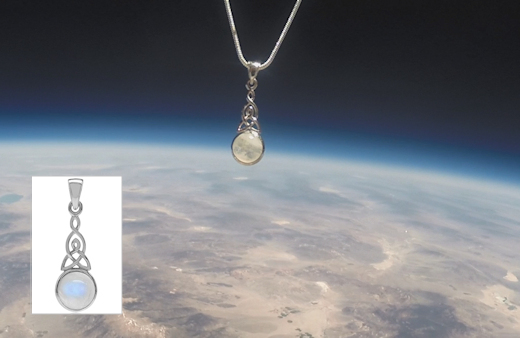
You can have it for $139.95. The students are selling these pendants to support their cosmic ray ballooning program. Each one comes with a greeting card showing the item in flight and telling the story of its journey to the edge of space. Sales support the Earth to Sky Calculus cosmic ray ballooning program and hands-on STEM research.
Far Out Gifts: Earth to Sky Store
All sales support hands-on STEM education