SOLAR WIND, INCOMING: A fast-moving stream of solar wind is approaching Earth. Estimated time of arrival: Sept. 7th. The gaseous material is flowing from a large hole in the sun's atmosphere. Arctic sky watchers should be alert for auroras later this week. Free: Aurora Alerts.

SHADOWS OF VENUS IN THE ATACAMA DESERT: The Atacama Desert in northern Chile is one of the best places in the world to look at the sky. The desert's unique combination of high altitude, clear skies and zero light pollution make it a global destination for astronomers. On Sept. 1st, astronomer Daniele Gasparri was standing under the Milky Way in the Atacama Desert when something caught his eye--not up in the sky, but rather on the side of his car. "It was my Venus shadow!" he says.

"The sky in Atacama is so dark that even the light of Venus can generate clear shadows," marvels Gasparri. "Photographing it was easy. I used a Sony A7s camera with a 12 mm f2.8 fisheye lens. A single 30 second exposure at 6400 ISO revealed both the shadow on my car as well as the Milky Way just behind."
Unlike most people, Gasparri does not have to travel far to experience this astronomer's paradise. "I actually live in the Atacama desert, in the city of Copiapó, working toward my PhD in astronomy and planetary science at our local university, " he explains. "I often drive into the desert to take pictures of the sky. I first noticed the shadow cast by Venus a couple of months ago, but only few days ago I captured it with my camera. Actually the shadow is quite obvious, especially on a white background like my car."
How many people have seen themselves silhouetted by the light of another planet? In the Atacama Desert, it happens all the time. More of Gasparri's desert sky photos may be found at AstroAtacama.com.
Realtime Space Weather Photo Gallery
SUN HALOS OVER YELLOWKNIFE: As summer comes to an end in Arctic Canada, there's a chill in the air heralding the approach of autumn. The change of seasons is also changing the morning sun, which is increasingly attended by beautiful ice halos. Yesterday, Stephen Bedingfield photographed this sunrise display from Yellowknife in the Northwest Territories:

The luminous forms are caused by sunlight shining through icy crystals in cirrus clouds. Usually ice halos are simple, like a solitary pillar or an uncomplicated ring. In this case, however, a complex assortment of halos surrounded the sun. There was an upper and a lower tangent arc, a Parry arc, an infralateral arc, a parhelic circle, a 22-degree halo, and a pair of sundogs. Confused? Here's a finder chart.

The variety of halos Bedingfield witnessed was caused by a corresponding variety of ice crystals tumbling through the northern morning air. Stay tuned for more of these as the icy season begins.
Realtime Space Weather Photo Gallery
FLY ME TO THE MOONSTONE: Are you looking for a far-out gift? Nothing says "I love you" like a moonstone from the edge of space. On Jan 27th, the students of Earth to Sky Calculus flew this moonstone wrapped in a hand-crafted sterling silver Celtic love knot 35.1 km (115,158 feet) above Earth's surface:
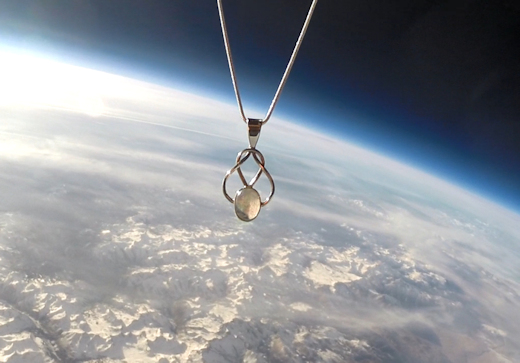
You can have it for $179.95. The students are selling these pendants to support their cosmic ray ballooning program. Each one comes with a greeting card showing the item in flight and telling the story of its journey to the edge of space. All sales support the Earth to Sky Calculus cosmic ray ballooning program and hands-on STEM research.
Far Out Gifts: Earth to Sky Store
All sales support hands-on STEM education