SOLAR WIND, INCOMING: A fast-moving stream of solar wind is approaching Earth. Estimated time of arrival: Sept. 7-8. The gaseous material is flowing from a hole in the sun's atmosphere. Arctic sky watchers should be alert for auroras later this week. Free: Aurora Alerts.

JUPITER HAS AN EXTRA MAGNETIC POLE: When NASA's Juno spacecraft reached Jupiter in 2016, planetary scientists were eager to learn more about the giant planet's magnetic field. Juno would fly over both of Jupiter's poles, skimming just 4000 km above the cloudtops for measurements at point-blank range. Today in the journal Nature, a team of researchers led by Kimberly Moore of Harvard University announced new results from Juno--and they are weird. Among the findings: Jupiter has an extra magnetic pole.
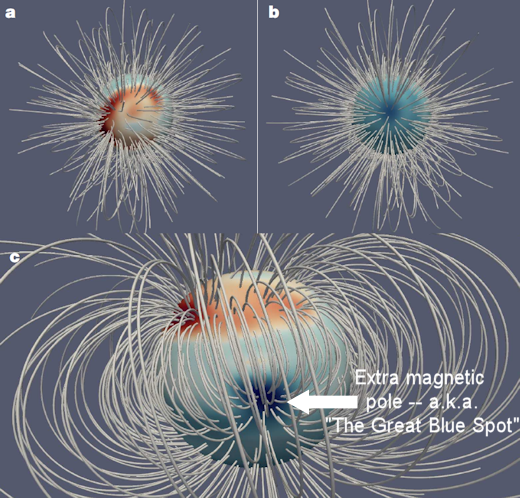
Above: Jupiter's magnetic field lines. (a) north polar view; (b) south polar view; (c) equatorial view
"We find that Jupiter's magnetic field is different from all other known planetary magnetic fields," the researchers wrote in the introduction to their paper.
The best way to appreciate the strangeness of Jupiter's magnetic field is by comparison to Earth. Our planet has two well-defined magnetic poles--one in each hemisphere. This is normal. Jupiter's southern hemisphere looks normal, too. It has a single magnetic pole located near the planet's spin axis.
Jupiter's northern hemisphere, however, is something else. The north magnetic pole is smeared into a swirl, which some writers have likened to a "ponytail." And there is a second south pole located near the equator. The researchers have dubbed this extra pole "The Great Blue Spot" because it appears blue in their false-color images of magnetic polarity..
In their Nature article, the scientists consider the possibility that we are catching Jupiter in the middle of a magnetic reversal--an unsettled situation with temporary poles popping up in strange places. However, they favor the idea that Jupiter's inner magnetic dynamo is simply unlike that of other planets. Deep within Jupiter, they posit, liquid metallic hydrogen mixes with partially dissolved rock and ice to create strange electrical currents, giving rise to an equally strange magnetic field.
More clues could be in the offing as Juno continues to orbit Jupiter until 2021. Changes to Jupiter's magnetic structure, for instance, might reveal that a reversal is underway or, conversely, that the extra pole is stable. Stay tuned for updates.
Realtime Space Weather Photo Gallery
FLY ME TO THE MOONSTONE: Are you looking for a far-out gift? Nothing says "I love you" like a moonstone from the edge of space. On Jan 27th, the students of Earth to Sky Calculus flew this moonstone wrapped in a hand-crafted sterling silver Celtic love knot 35.1 km (115,158 feet) above Earth's surface:
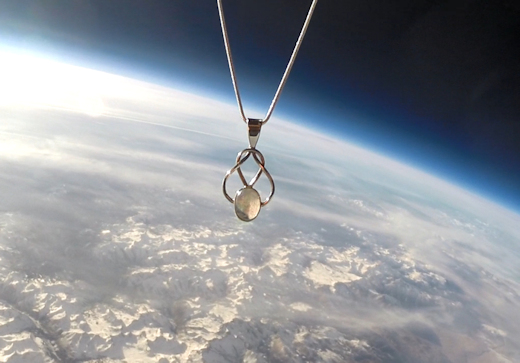
You can have it for $179.95. The students are selling these pendants to support their cosmic ray ballooning program. Each one comes with a greeting card showing the item in flight and telling the story of its journey to the edge of space. All sales support the Earth to Sky Calculus cosmic ray ballooning program and hands-on STEM research.
Far Out Gifts: Earth to Sky Store
All sales support hands-on STEM education
SUN HALOS OVER YELLOWKNIFE: As summer comes to an end in Arctic Canada, there's a chill in the air heralding the approach of autumn. The change of seasons is also changing the morning sun, which is increasingly attended by beautiful ice halos. Yesterday, Stephen Bedingfield photographed this sunrise display from Yellowknife in the Northwest Territories:

The luminous forms are caused by sunlight shining through icy crystals in cirrus clouds. Usually ice halos are simple, like a solitary pillar or an uncomplicated ring. In this case, however, a complex assortment of halos surrounded the sun. There was an upper and a lower tangent arc, a Parry arc, an infralateral arc, a parhelic circle, a 22-degree halo, and a pair of sundogs. Confused? Here's a finder chart.

The variety of halos Bedingfield witnessed was caused by a corresponding variety of ice crystals tumbling through the northern morning air. Stay tuned for more of these as the icy season begins.
Realtime Space Weather Photo Gallery