JUPITER AND THE MOON: When the sun goes down tonight, step outside and look southwest. The crescent Moon is passing by Jupiter, forming a bright pair in the twilight sky. Try to catch them before the sky fades to black. A Jupiter-Moon conjunction framed by cobalt blue is extra-beautiful: Sky map.

A NEW HOLE IN THE SUN'S ATMOSPHERE: Get ready for more auroras. A new hole in the sun's atmosphere is turning toward Earth. NASA's Solar Dynamics Observatory photographed the structure, shown here in a false-color UV image taken on Sept. 13th:

This is a "coronal hole"--a region where the sun's magnetic field opens up and allows solar wind to escape. The interior of the hole is black because the hot glowing gas normally contained there is missing. It's on its way to Earth.
Minor G1-class geomagnetic storms are possible when the gaseous material arrives on Sept. 16th or 17th. Deepening autumn darkness will favor the visibility of auroras around the Arctic Circle and possibly at lower latitudes, too, if the storm intensifies to category G2. On Sept. 11th, a similar solar wind stream sparked auroras over northern-tier US states such as Wisconsin and Minnesota. It could happen again in a few days. Free: Aurora Alerts


NOT EVERYTHING GREEN IS AN AURORA: Earlier this week, many northern watchers saw their skies turn green as a geomagnetic storm ignited bright auroras around the Arctic Circle. Giuseppe Petricca was one of them--but the green he saw from northern Scotland was not the aurora borealis. "It was airglow," says Petricca.

"The geomagnetic storm had been over for hours when I took this picture on Sept. 12th," he says. "It was my first time ever in observing this fantastic atmospheric phenomenon!"
Airglow only looks like the aurora borealis. It is caused by chemi-luminescent reactions in Earth's upper atmosphere. These reactions get started during daylight hours when the atmosphere is bathed in strong UV radiation from the sun. At night we see the afterglow--"airglow"--colored green by oxygen atoms 90-100 km high.
Airglow is best seen on moonless nights far from city lights--exactly the situation for Petricca on Sept. 12th. "It was an unforgettable night in the Outer Hebrides!" he says.
Realtime Airglow Photo Gallery
FLY ME TO THE MOONSTONE: Are you looking for a far-out gift? Nothing says "I love you" like a moonstone from the edge of space. On Jan 27th, the students of Earth to Sky Calculus flew this moonstone wrapped in a hand-crafted sterling silver Celtic love knot 35.1 km (115,158 feet) above Earth's surface:
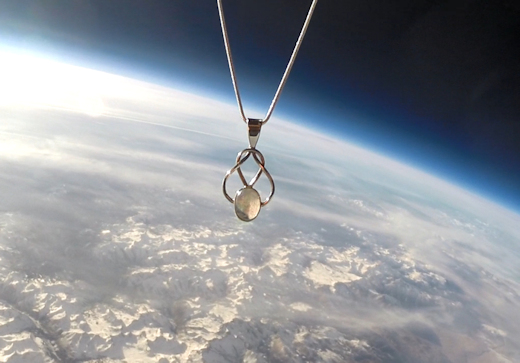
You can have it for $179.95. The students are selling these pendants to support their cosmic ray ballooning program. Each one comes with a greeting card showing the item in flight and telling the story of its journey to the edge of space. All sales support the Earth to Sky Calculus cosmic ray ballooning program and hands-on STEM research.
Far Out Gifts: Earth to Sky Store
All sales support hands-on STEM education