AURORAS AND THE HARVEST MOON: NOAA forecasters say that G1-class geomagnetic storms are possible on Sept. 23rd when a solar wind stream is expected to hit Earth's magnetic field. The gaseous material is flowing from an equatorial hole in the sun's atmosphere. Arctic auroras will mix with the light of the waxing Harvest Moon when the solar wind arrives. Free: Aurora Alerts


FIRST LIGHT FROM THE PARKER SOLAR PROBE: For more than 400 years, astronomers have studied the sun from afar. Now NASA is actually going there. The Parker Solar Probe, launched last month from Cape Canaveral, is plunging toward the sun for the closest approach any spacecraft has ever made to a star. Researchers hope it will solve mysteries related to the high temperature of the sun's atmosphere and the origin of the solar wind. NASA just turned on some of the spacecraft's science instruments, and "First Light" was spectacular:

This image was taken on Sept. 9th by the probe's wide field imager, WISPR, which combines views from two telescopes located behind the spacecraft's heat shield. On the left we see the Milky Way and the galactic center; on the right, there is Jupiter among the stars of the constellation Libra. WISPR did not look near the sun for this first test, but eventually it will.
WISPR is so sensitive, it can actually see the solar wind. Ultimately, when the Solar Probe gets close enough, it will make 3D images of the sun's inner atmosphere similar to medical CAT scans. The technique, called coronal tomography, is a fundamentally new approach to solar imaging and is only possible because the photography is performed from a moving platform close to the sun, flying through coronal clouds and streamers and imaging them as it flies by and through them. The information WISPR gains could result in improvements in space weather forecasting.
For more information about the Parker Solar Probe and other instruments on the spacecraft, visit the mission's home page at Johns Hopkins University.
Realtime Space Weather Photo Gallery
FLY ME TO THE MOONSTONE: Are you looking for a far-out gift? Nothing says "I love you" like a moonstone from the edge of space. On Jan 27th, the students of Earth to Sky Calculus flew this moonstone wrapped in a hand-crafted sterling silver Celtic love knot 35.1 km (115,158 feet) above Earth's surface:
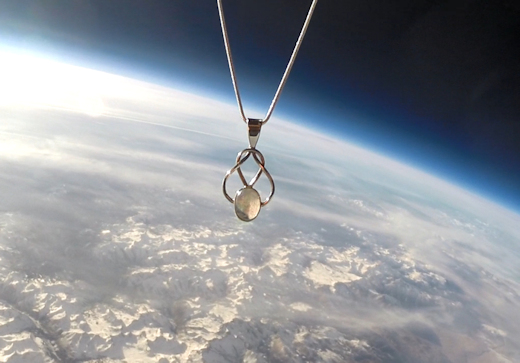
You can have it for $179.95. The students are selling these pendants to support their cosmic ray ballooning program. Each one comes with a greeting card showing the item in flight and telling the story of its journey to the edge of space. All sales support the Earth to Sky Calculus cosmic ray ballooning program and hands-on STEM research.
Far Out Gifts: Earth to Sky Store
All sales support hands-on STEM education