SOLAR MINIMUM CONDITIONS ARE IN EFFECT: So far this year, the sun has been without sunspots for more than 154 days--including the last 12 days straight. To find a similar stretch of blank suns, you have to go back to 2009 when the sun was experiencing the deepest solar minimum in a century. Solar minimum has returned, bringing extra cosmic rays, long-lasting holes in the sun's atmosphere, and strangely pink auroras. Free: Aurora Alerts
DUST STORMS ON TITAN: In many ways, Saturn's largest Moon Titan is uncannily similar to Earth. It has lakes, seas, beaches, a thick atmosphere, rain, seasons. On Sept. 24th, researchers reporting the journal Nature Geoscience added one more item to the list: dust storms.

Above: An artist's concept of a dust storm on Titan. [more]
The research team, led by French astronomer Sebastien Rodriguez of the Université Paris Diderot, found the storms in infrared images taken by NASA's Cassini spacecraft almost 10 years ago. At first the dust storms looked like clouds, but a closer look revealed their true nature: "[It was] dust raised from large dune fields around Titan's equator," says Rodriguez.

Dust on Titan is strange stuff. The research team believes it is made not of fine-grain sand, as dust would be on Earth. Instead, Titan's dust is organic, formed when organic molecules in the methane-rich atmosphere grow large enough to fall to the ground. Gusty winds pick those organic particles back up and blow them in choking clouds around the equator.
Some of the dust storms Cassini observed were so massive, they could only be lifted by very strong winds. This suggests that the underlying sand can be set in motion, too, and that the giant dunes covering Titan's equatorial regions are still active and continually changing. Read the original research here.
Realtime Space Weather Photo Gallery
FLY ME TO THE MOONSTONE: Are you looking for a far-out gift? Nothing says "I love you" like a moonstone from the edge of space. On June 12th, the students of Earth to Sky Calculus flew this moonstone wrapped in a sterling silver Celtic love knot 34.1 km (111,877 feet) above Earth's surface:
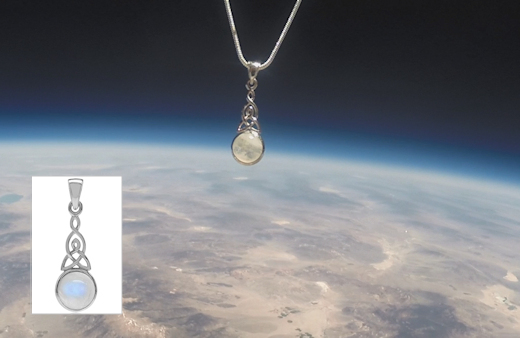
You can have it for $149.95. The students are selling these pendants to support their cosmic ray ballooning program. Each one comes with a greeting card showing the item in flight and telling the story of its journey to the edge of space. Sales support the Earth to Sky Calculus cosmic ray ballooning program and hands-on STEM research.
Far Out Gifts: Earth to Sky Store
All sales support hands-on STEM education