THE CHILL OF SOLAR MINIMUM: The sun is entering one of the deepest Solar Minima of the Space Age. Sunspots have been absent for most of 2018, and the sun's ultraviolet output has sharply dropped. New research shows that Earth's upper atmosphere is responding.
"We see a cooling trend," says Martin Mlynczak of NASA's Langley Research Center. "High above Earth's surface near the edge of space, our atmosphere is losing heat energy. If current trends continue, the upper atmosphere could soon set a Space Age record for cold."

Above: The TIMED satellite monitoring the temperature of the upper atmosphere
These results come from the SABER instrument onboard NASA's TIMED satellite. SABER monitors infrared emissions from carbon dioxide (CO2) and nitric oxide (NO), two substances that play a key role in the energy balance of air 100 to 300 kilometers above our planet's surface. By measuring the infrared glow of these molecules, SABER can assess the thermal state of gas at the very top of the atmosphere–a layer researchers call "the thermosphere."
"The thermosphere always cools off during Solar Minimum. It's one of the most important ways the 11-year solar cycle affects our planet," explains Mlynczak, the associate principal investigator for SABER.
When the thermosphere cools, it shrinks, literally decreasing the radius of the atmosphere. This shrinkage decreases aerodynamic drag on satellites in low-Earth orbit, extending their lifetimes. That's the good news. The bad news is, it also delays the natural decay of space junk, resulting in a more cluttered environment around Earth.

Above: Layers of the atmosphere. The cooling measured by SABER is happening in the thermosphere.
To help keep track of what's happening in the thermosphere, Mlynczak and colleagues recently introduced the "Thermosphere Climate Index" (TCI)–a number expressed in Watts that tells how much heat NO molecules are dumping into space. During Solar Maximum, the TCI is high ("Hot"); during Solar Minimum, it is low ("Cold").
"Right now, it is very low indeed," says Mlynczak. "SABER is currently measuring 33 billion Watts of infrared power from NO. That's 10 times smaller than we see during more active phases of the solar cycle."
Although SABER has been in orbit for only 17 years, Mlynczak and colleagues recently calculated TCI going all the way back to the 1940s. "SABER taught us to do this by revealing how TCI depends on other variables such as geomagnetic activity and the sun's UV output–things we have been measuring for decades," he explains. The historical record shows a strong correlation between TCI and the solar cycle:

Above: Recent studies by Mlynczak et al show that the state of the thermosphere varies with the solar cycle and may be discussed using a set of five plain language terms: Cold, Cool, Neutral, Warm, and Hot. [more]
As 2018 comes to an end, the thermosphere is on the verge of setting a Space Age record for Cold. "We're not there quite yet," says Mlynczak, "but it could happen in a matter of months."
Soon, the Thermosphere Climate Index will be added to Spaceweather.com as a regular data feed, so our readers can monitor the state of the upper atmosphere just as researchers do. Stay tuned.
An expanded and sharable version of this story is available here.
Realtime Space Weather Photo Gallery
WHERE NO CRYSTAL SPACESHIP HAS GONE BEFORE: On Sept. 24, 2018, the students of Earth to Sky Calculus launched the starship Enterprise to the stratosphere. Riding onboard a high-altitude cosmic ray balloon, the laser-etched crystal spaceship traveled 34.7 km (113,845 feet) above Earth's surface:
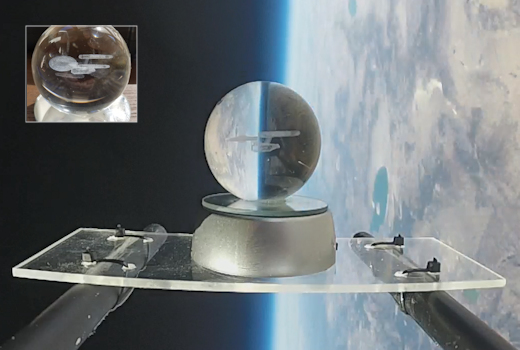
You can have it for $149.95. The students are selling the Enterprise to support their cosmic ray ballooning program. Each starship comes with a greeting card showing the item in flight and telling the story of its journey to the edge of space. Also included is a multi-colored LED illuminated stand (shown in the picture above). This creates a colorful visual effect and allows the Enterprise to be used as a far-out night light.
Far Out Gifts: Earth to Sky Store
All sales support hands-on STEM education