THE CHILL OF SOLAR MINIMUM: The sun is entering a deep Solar Minimum, and Earth's upper atmosphere is responding. Data from NASA's TIMED satellite show that the thermosphere (the uppermost layer of air around our planet) is cooling and shrinking, literally decreasing the radius of the atmosphere. If current trends continue, the thermosphere could set a Space Age record for cold in the months ahead: full story.
A GREEN FLASH ON VENUS: Green flashes on the sun are so rare, they were once thought to be mythological. Saturday evening in Rome, Paolo Palma witnessed a green flash with real ties to mythology: A green flash on Venus. "The planet was low on the horizon and its light looked like a long fiery bubble, with flames of red, orange, yellow and green," says Palma. "When Venus went below the horizon, the last ray was clearly green in color."

"I took this picture using my smartphone at the eyepiece of a 12-inch telescope at 76x magnification," he says.
Green flashes on the sun are formed when the prismatic action of the atmosphere splits the setting sun into basic R-G-B colors. Temperature inversions (usually above a sea surface) create a mirage, magnifying the green into an eye-catching flash. The same physics created this green flash on Venus. "The sea is only 8 km away from me!" notes Palma.
Now is a good time to look for green flashes on Venus. The second planet is approaching the sun and thinning into a narrow crescent--like a miniature crescent Moon. The long skinny profile of Venus is easily split into R-G-B colors as it beams over the horizon, setting the stage for beautiful atmospheric optics.
Realtime Green Flash Photo Gallery
SOLAR MINIMUM SUNSPOT: Dust off your solar telescopes. There's a new sunspot facing Earth. "After two weeks with no sunspots at all, AR2723 was a welcome sight," says Maximilian Teodorescu who sends this picture from Magurele, Romania:

"This double spot looks so great despite being rather small compared to the larger spots of Solar Maximum," says Teodorescu.
The two primary dark cores of AR2723 are almost as wide as Earth, making them easy targets for safely-filtered backyard optics. However, don't expect to catch this Solar Minimum spot in mid-flare. So far the sunspot group has a stable magnetic field that seems disinclined to explode. Free: Aurora Alerts.
Realtime Space Weather Photo Gallery
WHERE NO CRYSTAL SPACESHIP HAS GONE BEFORE: On Sept. 24, 2018, the students of Earth to Sky Calculus launched the starship Enterprise to the stratosphere. Riding onboard a high-altitude cosmic ray balloon, the laser-etched crystal spaceship traveled 34.7 km (113,845 feet) above Earth's surface:
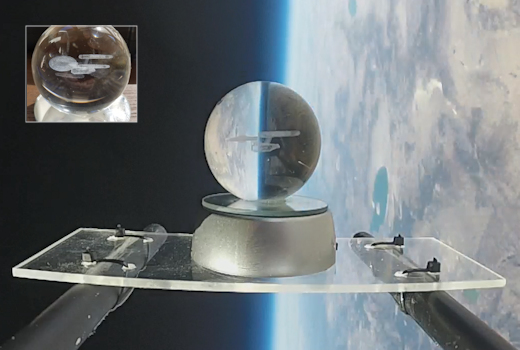
You can have it for $149.95. The students are selling the Enterprise to support their cosmic ray ballooning program. Each starship comes with a greeting card showing the item in flight and telling the story of its journey to the edge of space. Also included is a multi-colored LED illuminated stand (shown in the picture above). This creates a colorful visual effect and allows the Enterprise to be used as a far-out night light.
Far Out Gifts: Earth to Sky Store
All sales support hands-on STEM education