G2-CLASS GEOMAGNETIC STORM WATCH: NOAA has upgraded their watch for geomagnetc storms on Oct. 7-8 from G1 (minor) to G2 (moderately strong). This is in response to a stream of solar wind approaching Earth from a large hole in the sun's atmosphere, described below. Arctic auroras are almost certain to appear when the gaseous material arrives, and the light show could descend to northern-tier US States such as Maine, Michigan, and Washington. Free: Aurora alerts.


CORONAL CANYON FACES EARTH: A large canyon-shaped hole has opened in the sun's atmosphere, and it is directly facing Earth. NASA's Solar Dynamics Observatory took this false-color ultraviolet image of the structure on Oct. 5th:

This is a coronal hole--a place in the sun's atmosphere where magnetic fields open up and allow solar wind to escape. Coronal holes are common, but this one is unusually large. It stretches more than 900,000 km from the sun's north polar crown across the equator into the sun's southern hemisphere. Now that's a grand canyon.
The emerging stream of solar wind will reach Earth on Oct. 7th bringing a 65% chance of minor G1-class geomagnetic storms, possibly intensifying to G2-class on Oct. 8th according to NOAA. Such storms can affect migratory animals that use magnetic cues for navigation and spark auroras visible in the USA as far south as a line from Maine to Washington. Free: Aurora alerts.
RAINBOW COLORED MINI-CRESCENT MOON: In recent weeks, careful observers of the sunset sky have noticed something unusual near the western horizon. "It looks like a miniature crescent moon," reports Radu Anghel of Bacau, Romania. In other words, Venus:

Venus is about to pass between Earth and the sun, turning its night side toward us. This naturally gives the planet a crescent shape. And that's not all. "Venus looks a bit like a rainbow," adds Anghel. Why? The thinning arc of Venus' sunlit clouds is split into its constituent colors by the prismatic action of Earth's atmosphere.
See for yourself. Venus is about 6 degrees above the western horizon at sunset, surrounded by twilight but still easy to see because of its great brightness (magnitude -4.4). Just be careful not to point your optics too close to the setting sun.
FLY ME TO THE MOONSTONE: Are you looking for a far-out gift? Nothing says "I love you" like a moonstone from the edge of space. On June 12th, the students of Earth to Sky Calculus flew this moonstone wrapped in a sterling silver Celtic love knot 34.1 km (111,877 feet) above Earth's surface:
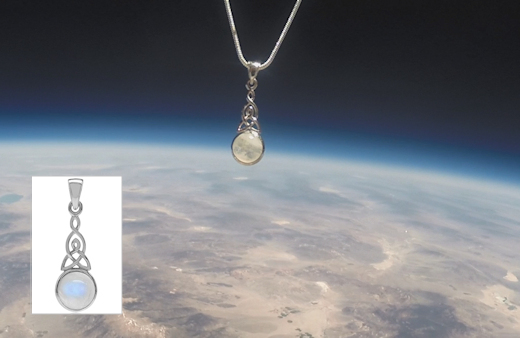
You can have it for $149.95. The students are selling these pendants to support their cosmic ray ballooning program. Each one comes with a greeting card showing the item in flight and telling the story of its journey to the edge of space. Sales support the Earth to Sky Calculus cosmic ray ballooning program and hands-on STEM research.
Far Out Gifts: Earth to Sky Store
All sales support hands-on STEM education