G2-CLASS GEOMAGNETIC STORM WATCH: A large canyon-shaped hole in the sun's atmosphere is facing Earth and spewing a stream of solar wind in our direction. NOAA forecasters say there is a 75% chance of geomagnetic storms on Oct. 7-8 when the gaseous material arrives. Storm levels could reach category G2. Such storms can affect migratory animals that use magnetic cues for navigation and spark auroras visible in the USA as far south as, e.g., Maine, Michigan and Washington. Free: Aurora alerts.


GIGANTIC JETS SEEN FROM SPACE: Last month, Frankie Lucena watched a barrage of Gigantic Jets shoot up from decaying Tropical Storm Isaac as it passed his home in Puerto Rico. Using Lucena's video of the outburst, researchers have pinpointed the same jets in images from the GOES-16 satellite looking straight down on the storm:
Gigantic Jets are a powerful form of upward-directed lightning related to sprites. Before 2017, Gigantic Jet sightings numbered in the dozens. All by itself, Tropical Storm Isaac produced at least 8 Gigantic Jets in a single night. Researchers still don't know why some storms produce many of these exotic bolts, and others none.
The satellite images of Isaac's Gigantic Jets come from the Geostationary Lightning Mapper (GLM) onboard GOES-16. GLM is a near-infrared/optical sensor that can detect momentary changes in an optical scene, indicating the presence of lightning in cloudtops. "This experimental method of analyzing a Gigantic Jet was first thought of by Levi Boggs of the Florida Institute of Technology and he is currently writing a paper on this subject," says Lucena.
Realtime Gigantic Jet Photo Gallery
FLY ME TO THE MOONSTONE: Are you looking for a far-out gift? Nothing says "I love you" like a moonstone from the edge of space. On June 12th, the students of Earth to Sky Calculus flew this moonstone wrapped in a sterling silver Celtic love knot 34.1 km (111,877 feet) above Earth's surface:
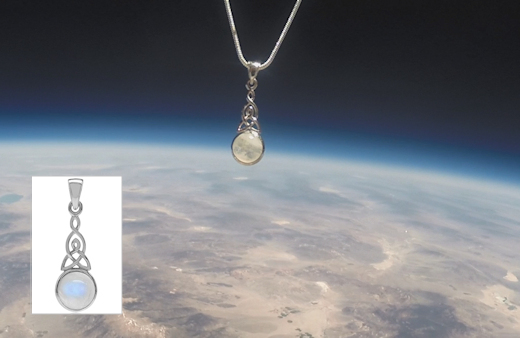
You can have it for $149.95. The students are selling these pendants to support their cosmic ray ballooning program. Each one comes with a greeting card showing the item in flight and telling the story of its journey to the edge of space. Sales support the Earth to Sky Calculus cosmic ray ballooning program and hands-on STEM research.
Far Out Gifts: Earth to Sky Store
All sales support hands-on STEM education
COMING SOON, THE COMET OF THE YEAR: Astronomers are calling Comet 46P/Wirtanen the "comet of the year." On Dec. 16th, the kilometer-wide ball of dirty ice will come within 11.5 million km of Earth, potentially making it a naked eye object for several weeks. However, it's not the comet of the year yet. "For now, Comet Wirtanen is still rather faint," reports Maximilian Teodorescu, who photographed it from Magurele, Romania:

That tiny fuzzball near the center of Teodorescu's image is 46P/Wirtanen passing through the southern constellation Fornax on Oct. 5th. Forecasters expect it to brighten at least 200-fold by December. Comets are frequently unpredictable so the peak brightness is uncertain. Some forecasters think 46P/Wirtanen could ultimately reach magnitude +3 or +4, making it not a Great Comet but a very good one, visible to the unaided eye and a wonderful target for binoculars or small telescopes.
Comet Wirtanen passes through the inner solar system every 5.4 years. Right now it is near the orbit of Mars, and it is heading in our direction. Click on the image to explore the comet's approach, courtesy of NASA/JPL:

Got a picture of Comet 46P/Wirtanen? Submit it here.
Realtime Space Weather Photo Gallery