CHANCE OF STORMS TODAY: NOAA forecasters say there is a 75% chance of minor G1-class geomagnetic storms today, Oct. 8th, as Earth passes through a fast-moving stream of solar wind. The gaseous material is flowing from a large canyon-shaped hole in the sun's atmosphere. Arctic sky watchers should be alert for auroras after nightfall. Free: Aurora alerts.


AQUATIC AURORAS: Yesterday, Oct. 7th, a stream of solar wind hit Earth's magnetic field, sparking G1-class geomagnetic storms for more than 9 consecutive hours. Matti Helin watched the resulting Northern Lights while wading waist-deep in an Arctic Finnish lake:

"The first hints of green were visible about an hour after the sunset," says Helin. "I drove to a lake far from the city lights. As the auroras intensified, I waded into the lake and waited in the waist deep water for this shot. It was an extremely beautiful display!"
SOUTHERN CALIFORNIA ROCKET LAUNCH: Last night, shortly after sunset, sonic booms rumbled across the southern California landscape. The loud sounds alerted residents of the area to look up, and this is what they saw:

"It was a Falcon 9 rocket launch," says Behyar Bakhshandeh, who photographed the exhaust hovering in the sky above Carlsbad, CA.
Residents described the expanding nebula, containing two active rocket stages and multiple shock waves as "exciting," "heart-stopping," "riveting," and "like an alien invasion!" But this was no alien. All the technology came from the Earth labs of SpaceX, which launched the rocket from the Vandenberg Air Force Base.
The Falcon 9 propelled an Argentine environmental satellite into orbit. The rocket's previously flown first stage then flipped around and returned to Vandenberg, chalking up SpaceX's first West Coast landing. The booster put on a spectacular show as it descended tail first, deploying four legs and firing up one of its nine engines to slow for touchdown in a cloud of fiery exhaust.
Realtime Space Weather Photo Gallery
WHERE NO SPACESHIP HAS GONE BEFORE: On Sept. 24, 2018, the students of Earth to Sky Calculus launched the starship Enterprise to the stratosphere. Riding onboard a high-altitude cosmic ray balloon, the laser-etched crystal spaceship traveled 34.7 km (113,845 feet) above Earth's surface:
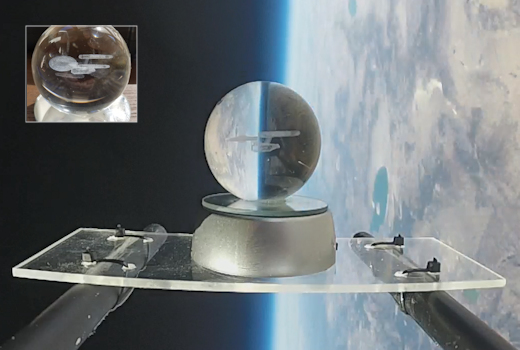
You can have it for $149.95. The students are selling the Enterprise to support their cosmic ray ballooning program. Each starship comes with a greeting card showing the item in flight and telling the story of its journey to the edge of space. Also included is a multi-colored LED illuminated stand (shown in the picture above). This creates a colorful visual effect and allows the Enterprise to be used as a far-out night light.
Far Out Gifts: Earth to Sky Store
All sales support hands-on STEM education