THE SOLAR WIND CONTINUES TO BLOW: For the 3rd day in a row, Earth remains inside a stream of high-speed solar wind flowing from a canyon-shaped hole in the sun's atmosphere. NOAA forecasters say there is a 40% chance of minor G1-class geomagnetic storms on Oct. 9th as our planet's magnetic field is buffeted by the gaseous material. Arctic sky watchers should remain alert for auroras. Free: Aurora alerts.


STRANGE AURORA SOUNDS: On Oct. 7th, a solar wind stream hit Earth's magnetic field, sparking a G1-class geomagnetic storm. In southern Finland, the night sky turned green as energetic particles rained down on the upper atmosphere. Prof. Emeritus Unto K. Laine of Finland's Aalto University went outside for the show--to watch and to listen. "This aurora night produced many sound events of different types, like crackles and claps," says Laine, who audio-recorded the event. To hear a sample 'clap', click on the image–and don't forget to turn up the volume:

"This particular sound event was one of the strongest during the night," says Laine. "I recorded it in the vicinity of Fiskars village after the midnight (local time)."
Aurora sounds are controversial. Over the centuries, there have been many reports of strange sounds under the Northern Lights. However, researchers have struggled to explain the phenomenon and sometimes suggested that they might be imaginary. Laine is a believer: "We have been recording sounds like these for almost 20 years as part of the Auroral Acoustics Project."
Laine uses arrays of microphones, VLF radio receivers, and electric field sensors to pinpoint the sounds and assess local atmospheric charge. He finds that a temperature inversion layer in the atmosphere about 70 meters above the ground can cause a separation of + and – charges in the air. During some geomagnetic storms, the charge separation breaks down, causing air to move and a faint "clap" to be heard.
Think of it as geomagnetic thunder.

A spectral analysis of the "thunderclap" (above) shows dominant frequencies between 1 kHz and 2 kHz, squarely in the range of human hearing.
"These sounds are not rare on calm nights with a strong inversion layer," says Laine. "People who talk and walk around, concentrating on picture taking, might never hear a single sound related to aurora. You have to stop all other activities and focus on listening. We Finns are probably good at this because we have received over 300 reports of sound observations around the country during the Auroral Acoustics Project."
WHERE NO SPACESHIP HAS GONE BEFORE: On Sept. 24, 2018, the students of Earth to Sky Calculus launched the starship Enterprise to the stratosphere. Riding onboard a high-altitude cosmic ray balloon, the laser-etched crystal spaceship traveled 34.7 km (113,845 feet) above Earth's surface:
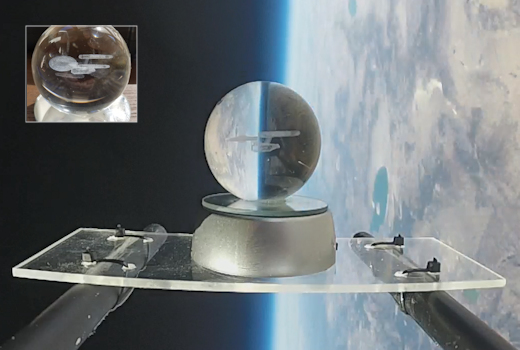
You can have it for $149.95. The students are selling the Enterprise to support their cosmic ray ballooning program. Each starship comes with a greeting card showing the item in flight and telling the story of its journey to the edge of space. Also included is a multi-colored LED illuminated stand (shown in the picture above). This creates a colorful visual effect and allows the Enterprise to be used as a far-out night light.
Far Out Gifts: Earth to Sky Store
All sales support hands-on STEM education