MINOR GEOMAGNETIC STORM, NOW: A minor G1-class geomagnetic storm is underway on Oct. 10th as Earth exits a stream of high-speed solar wind. Arctic sky watchers should be alert for auroras after nightfall. Free: Aurora alerts.

GEOMAGNETIC THUNDER? SOME AURORAS MAKE NOISE: On Oct. 7th, a solar wind stream hit Earth's magnetic field, sparking a G1-class geomagnetic storm. In southern Finland, the night sky turned green as energetic particles rained down on the upper atmosphere. But there was more to the show than beautiful lights.
"The storm also produced a number of distinctive sounds including crackles and claps," reports Prof. Emeritus Unto K. Laine of Finland's Aalto University. "Here is a recording of one of the strongest sounds of the night--a sharp clap." Click to listen:

"I recorded this in the vicinity of Fiskars village after midnight local time," he says.
Auroral sounds are controversial. Over the centuries, there have been many reports of strange sounds under the Northern Lights. However, researchers have struggled to explain the phenomenon and sometimes suggested that they might be imaginary. Laine is a believer: "We have been recording sounds like these for almost 20 years as part of the Auroral Acoustics Project." More samples may be found here.
Laine has developed arrays of microphones that can pinpoint the sounds through triangulation. He finds that they occur about 70 meters above the ground. Temperature inversion layers at that altitude can cause a separation of + and – charges in the air. During some geomagnetic storms, the charge separation breaks down, causing air to move and a faint "clap" to be heard.
Think of it as geomagnetic thunder.
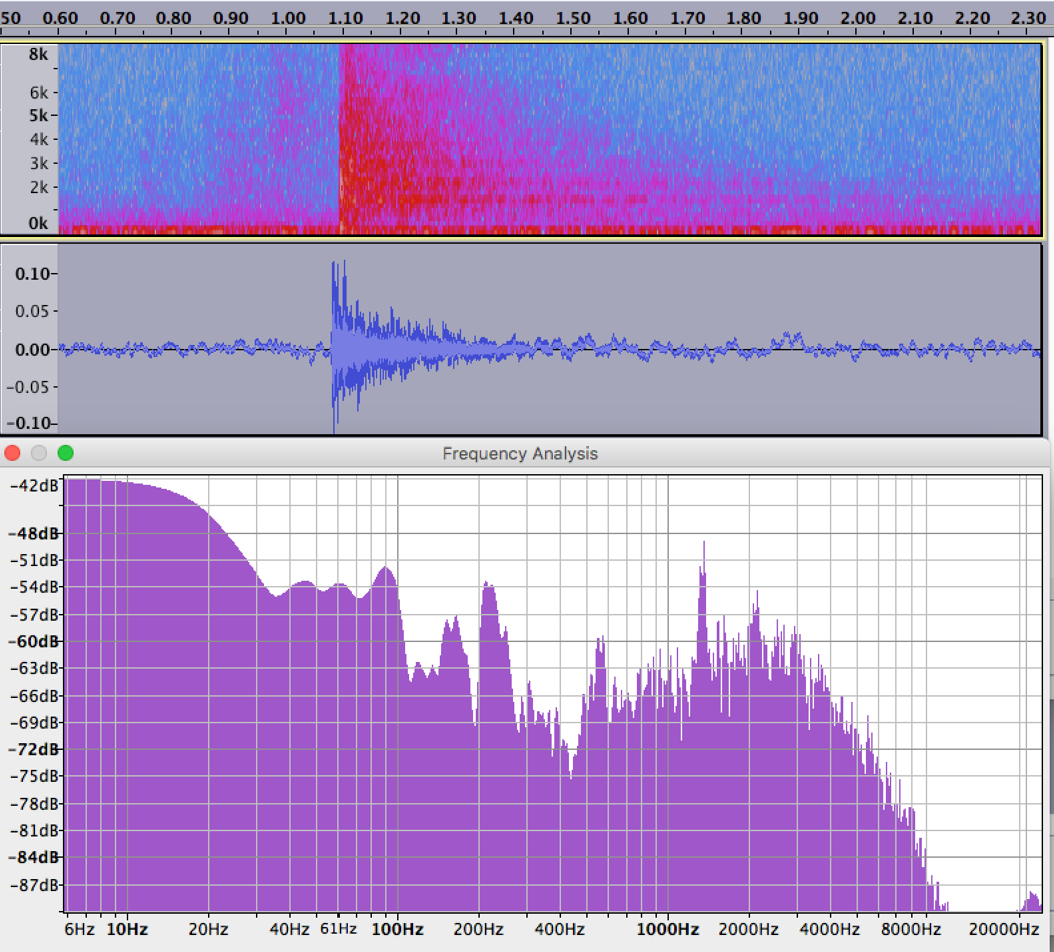
A spectral analysis of the "thunderclap" (above) shows dominant frequencies between 1 kHz and 2 kHz, squarely in the range of human hearing. You have to be quiet to hear them, though.
"People who talk and walk around, concentrating on picture taking, might never hear a single sound related to aurora," says Laine. "You have to stop all other activities and focus on listening. We Finns are probably good at this because we have received more than 300 reports of sound observations during the Auroral Acoustics Project."
Over the years, Laine has learned that a geomagnetic storm, by itself, is not enough to produce these thunderclaps. "A strong inversion layer is also required," he says. "The inversion layer acts like an electrostatic loudspeaker. Without it there are no sounds." This explains why many geomagnetic storms are silent. The local weather has to be just right -- as it was on Oct. 7th.
HOUSTON ASTROS IN THE STRATOSPHERE: The Astros are in the playoffs. Now they're in the stratosphere, too. Just a few days ago, the students of Earth to Sky Calculus launched this Houston Astros baseball 113,845 feet above Earth's surface using a high-altitude cosmic ray balloon:
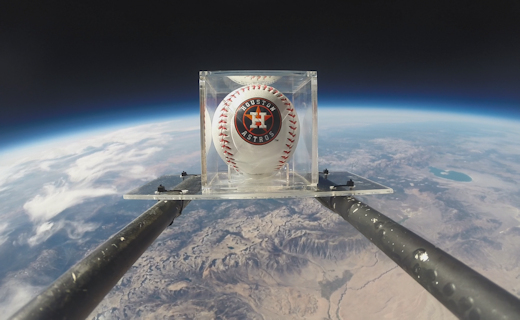
You can have it for $149.95. The students are selling space baseballs to support their cosmic ray ballooning program. Not an Astros fan? No problem. You can also purchase space baseballs for the Red Sox, Dodgers, Brewers, Braves, Cubs, Cardinals, Royals, Angels, Padres, Giants or any other team.
Each baseball comes with a greeting card showing the ball in flight and telling the story of its journey to the stratosphere. Plus, you'll receive a UV-resistant cubical display case with decorating stickers depicting the ball at the edge of space.
Far Out Gifts: Earth to Sky Store
All sales support hands-on STEM education