MINOR GEOMAGNETIC STORM IN PROGRESS: A minor G1-class geomagnetic storm is underway on Oct. 13th. Why? An equinox crack in Earth's magnetic field is allowing solar wind to enter our planet's magnetosphere. Arctic sky watchers should be alert for auroras after local nightfall. Free: Aurora Alerts.

DRACONID METEOR OUTBURST: On Oct. 8-9, Europeans outdoors around midnight were amazed when a flurry of faint meteors filled the sky. "It was a strong outburst of the annual Draconid meteor shower," reports Jure Atanackov, a member of the International Meteor Organization who witnessed the display from Slovenia. Between 22:00 UT (Oct. 8) and 01:00 UT (Oct. 9), dark-sky meteor rates exceeded 100 per hour. In eastern France, Tioga Gulon saw "1 to 2 meteors per minute," many of them shown here in an image stacked with frames from his video camera:

"It was a rare and impressive event," says Atanackov.
It could easily have been 10 times more impressive. In fact, Earth narrowly dodged a meteor storm.
The European outburst occurred as Earth skirted a filament of debris from Comet 21P/Giacobini-Zinner. If that filament had shifted in our direction by a mere 0.005 AU (~500,000 miles), Earth would have experienced a worldwide storm of 1000+ meteors per hour. These conclusions are based on a computer model of the comet's debris field from the University of Western Ontario's Meteor Physics Group. Here it is, showing Earth shooting the gap between two filaments of comet dust:

Western Ontario postdoctoral researcher Auriane Egal created the model and predicted the outburst before it happened. Egal's model was in good agreement with a rival model from NASA, so confidence was high. Meteors seen over Europe came from the larger filament on the right.
According to the models, Earth's L1 and L2 Lagrange points were both forecast to have storm-level activity--especially L2 which would experience the Earth-equivalent of 4000+ meteors per hour. This prompted NASA to take a close look at the danger to spacecraft.
"The US has four space weather spacecraft at L1: ACE, SOHO, Wind, and DSCOVR," says Bill Cooke of NASA's Meteoroid Environment Office. "There is only one operational spacecraft at L2 - the European Space Agency's GAIA - which was where most of the Draconid activity was expected to take place. GAIA shut down science operations for a few hours around the projected storm peak and re-oriented to turn the hard side of the vehicle towards the incoming debris. All of the spacecraft came through the Draconids without incident, and this shower provided a good test of our ability to forecast meteor activity outside of Earth orbit."
Many readers have wondered if the outburst has anything to do with Comet 21P/Giacobini-Zinner's close approach to Earth last month. "No," says Cooke. "The models show the outburst experienced at Earth was mainly caused by material ejected from the comet from 1945 to the mid 1960's. The meteoroids were more than half a century old."
FLY ME TO THE MOONSTONE: Are you looking for a far-out gift? Nothing says "I love you" like a moonstone from the edge of space. On Jan 27th, the students of Earth to Sky Calculus flew this moonstone wrapped in a hand-crafted sterling silver Celtic love knot 35.1 km (115,158 feet) above Earth's surface:
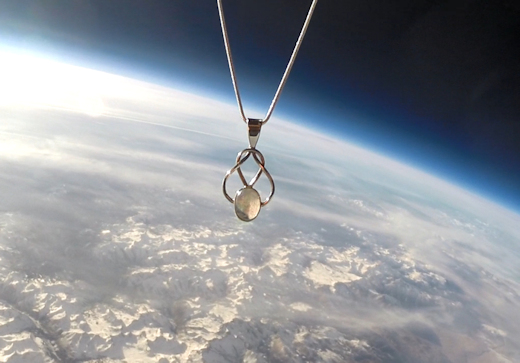
You can have it for $179.95. The students are selling these pendants to support their cosmic ray ballooning program. Each one comes with a greeting card showing the item in flight and telling the story of its journey to the edge of space. All sales support the Earth to Sky Calculus cosmic ray ballooning program and hands-on STEM research.
Far Out Gifts: Earth to Sky Store
All sales support hands-on STEM education
BERSERK AURORAS: You never know what might happen under the Northern Lights. "I was photographing a very mild display from Hvítserkur, Iceland, on Oct. 9th when suddenly the auroras went berserk," reports Olivier Staiger. "I didn't have time to change the camera settings, so my Canon EOS 6D completely overexposed this wild event."

Staiger's video of the outburst is a must-see. Play it now--and don't forget to turn up the volume to hear the cries of delight.
This kind of luminous explosion is called an "auroral substorm." During a substorm, ordinary auroras can abruptly transform into raging displays of light, sometimes even casting shadows on the ground. NASA's THEMIS spacecraft has shown that some substorms occur when auroras collide: A fast-moving, intense knot of auroral light swoops in from the north and interacts with more leisurely quiescent auroras. The combination produces a display best described as "B E R S E R K," says Staiger.
Staiger looked up the definition of berserk in the Merriam-Webster dictionary and found two entries: (1) an ancient Scandinavian warrior frenzied in battle and held to be invulnerable; and (2) one whose actions are recklessly defiant. "I LOVE the ancient Scandinavian warrior definition," says Staiger. "I think that's what I saw."
Realtime Space Weather Photo Gallery