THE MOON AND MARS--TONIGHT: When the sun goes down tonight, step outside and face south. The waxing gibbous Moon is approaching Mars for a conjunction in the constellation Capricornus. Mars is distinctly red and it shines about 6x brighter than a 1st magnitude star--easy to see even beside the glaring Moon. Try to look before the sky fades to black. The pair will look extra beautiful surrounded by twilight blue. Sky maps: Oct. 17, 18.


GEOMAGNETIC STORM PREDICTED: NOAA forecasters say there is a 55% chance of G1-class geomagnetic storms on Oct. 19th when a stream of solar wind is expected to graze Earth's magnetic field. The gaseous material is flowing from a north polar hole in the sun's atmosphere, shown here in an extreme ultraviolet image from NASA's Solar Dynamics Observatory:


Most of the solar wind stream will miss Earth, sailing north of our planet. However, the southern extension of the hole will send just enough material our way to potentially trigger a storm--especially if an equinox crack opens when the solar wind arrives. Arctic sky watchers should be alert for auroras before the weekend. Free: Aurora Alerts.
RED AURORAS OVER SVALBARD: Three nights ago, auroras filled the sky over Svalbard, one of the northernmost inhabited places on Earth. That's nothing unusual. Located between the northern coast of Norway and the North Pole, the Arctic island is frequently illuminated by the glow of geomagnetic activity. Seldom, however, are the Northern Lights so red:

Ruslan Merzlyakov took the picture overlooking Svalbard's Mt. Sarkofagen. "I've never seen auroras so colorful before," says Merzlyakov, a veteran observer of Northern Lights.
Auroras are normally green. The verdant glow comes from oxygen atoms excited by geomagnetic activity about 150 km above Earth's surface. Rare red auroras are also caused by oxygen atoms--but at a much higher altitude, between 150 km and 500 km. At those heights, the temperature and density of the atmosphere favors atomic transitions that emit red photons. Indeed, Merzlyakov's photo shows red stacked on top of green just as theory predicts.
Merzlyakov notes that the auroras did not look this red to his unaided eye. "My camera drew out the colors from a more monocromatic display," he says. "Even so--what a show!"
THE PLUTO PENDANT: When NASA's New Horizons spacecraft flew past Pluto in the summer of 2015, planetary scientists were amazed by what they saw: towering mountains, methane dunes, deep canyons. Most amazing of all was the giant heart in Pluto's southern hemisphere--an expanse of geologically fresh terrain named "Tombaugh Regio". Now you can wear Pluto next to your own heart:
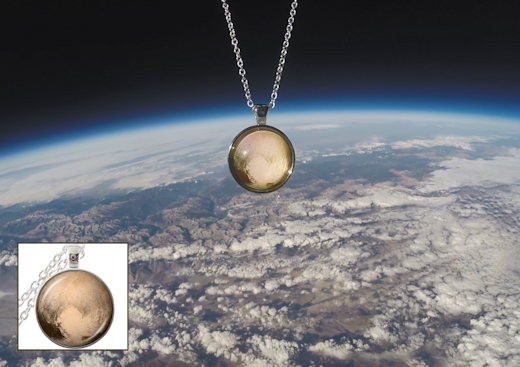
On Oct 11th the students of Earth to Sky Calculus launched this pendant to the edge of space using a high altitude cosmic ray balloon. It reached an altitude of 35.6 km (116,798 feet) above Earth's surface. You can have it for $119.95. The students are selling these pendants support their cosmic ray ballooning program.
Bonus: If you buy one this week, you may have a "Pluto is a Planet" Space Pendant free of charge.
Each pendant comes with a unique gift card showing the item at the edge of space and telling the story of its flight. Proceeds support Earth to Sky Calculus and hands-on STEM research.
Far Out Gifts: Earth to Sky Store
All sales support hands-on STEM education