GEOMAGNETIC STORM PREDICTED: NOAA forecasters say there is a 60% chance of G1-class geomagnetic storms on Oct. 19th when a stream of solar wind is expected to graze Earth's magnetic field. The gaseous material is flowing from a northern hole in the sun's atmosphere. Arctic sky watchers should be alert for auroras before the weekend. Free: Aurora Alerts.


FLOATING LIGHT PILLARS: On the night of Oct. 16th, Vincent Brady of Paradise, Michigan, went outside to look for auroras. He saw something similar--yet completely different. "There were colorful pillars of light floating over Whitefish Bay," he says. "What a pleasant surprise."
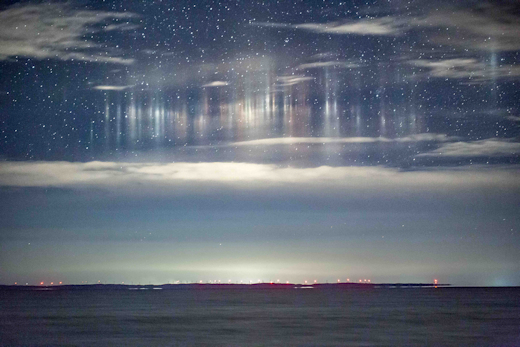
These pillars resemble auroras, but they have nothing to do with space weather. Light pillars are caused by ice crystals in the air which intercept manmade lights and spread them into colorful columns. No solar activity is required for the phenomenon. The only ingredients are ice and light pollution.
"The red lights are from wind turbines around the Canadian island Ile Parisienne," explains Brady. Other colors correspond to high pressure sodium lamps (warm orange) and modern LED lamps (blue-white).
Light pillars are a common sight at northern latitudes, especially when freezing winter air fills with crystals of ice. Normally, however, light pillars spring up from the ground where the urbans lights are located. "These were floating high above the ground," notes Brady. "That must have been where the ice crystals were on this early autumn night."
BRIGHT GREEN FIREBALL: For a split second on Oct. 14th, some of the largest telescopes in the world were temporarily blinded by a flash of light. It was a fireball, exploding above Hawaii's Mauna Kea volcano with the luminosity of a waxing crescent Moon:

Frankie Lucena of Puerto Rico noticed the meteor in footage gathered by the Canada-France-Hawaii Telescope's automated Cloudcam. "I was searching the camera's online database for red sprites when I came across this very bright fireball that lit up the sky," says Lucena. "It was so bright that the dome of one of the observatories managed to capture the green reflection of the fireball."
To find the origin of this incredible meteoroid, Lucena created a constellation map of the sky behind the fireball. It seems to come from no known meteor shower. In other words, it is a "sporadic"--a random piece of space debris swept up by Earth as it orbits the sun. Sporadic fireballs are more frequent than you think.

Realtime Space Weather Photo Gallery
THE PLUTO PENDANT: When NASA's New Horizons spacecraft flew past Pluto in the summer of 2015, planetary scientists were amazed by what they saw: towering mountains, methane dunes, deep canyons. Most amazing of all was the giant heart in Pluto's southern hemisphere--an expanse of geologically fresh terrain named "Tombaugh Regio". Now you can wear Pluto next to your own heart:
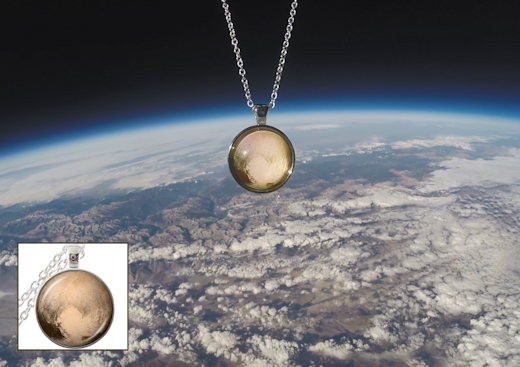
On Oct 11th the students of Earth to Sky Calculus launched this pendant to the edge of space using a high altitude cosmic ray balloon. It reached an altitude of 35.6 km (116,798 feet) above Earth's surface. You can have it for $119.95. The students are selling these pendants support their cosmic ray ballooning program.
Bonus: If you buy one this week, you may have a "Pluto is a Planet" Space Pendant free of charge.
Each pendant comes with a unique gift card showing the item at the edge of space and telling the story of its flight. Proceeds support Earth to Sky Calculus and hands-on STEM research.
Far Out Gifts: Earth to Sky Store
All sales support hands-on STEM education