GEOMAGNETIC STORM PREDICTED: NOAA forecasters say there is a 60% chance of G1-class geomagnetic storms on Oct. 19th when a stream of solar wind is expected to graze Earth's magnetic field. The gaseous material is flowing from a northern hole in the sun's atmosphere. Arctic sky watchers should be alert for auroras before the weekend. Free: Aurora Alerts.


METEORS FROM HALLEY'S COMET: Right now, specks of dust from Halley's Comet are disintegrating in Earth's atmosphere, kicking off the annual Orionid meteor shower. NASA cameras caught more than a dozen Orionid fireballs streaking across the USA during the past 48 hours, and the show is expected to improve during the weekend as Earth moves deeper into Halley's stream of debris:
Above: Ian Webster created this interactive visualization of Halley's debris stream cutting across Earth's orbit.
"The upcoming Orionids should provide a fairly good show for most visual observers," says Peter Brown of the University of Western Ontario Meter Physics Group. "The shower's radiant is already quite active and well defined in data from the Canadian Meteor Orbit Radar (CMOR)."
Orionids appear every year around this time when Earth crosses Halley's debris stream, with the shower typically producing about 20 meteors per hour. Some of the brightest stars and constellations in the sky--e.g., Orion the Hunter, Sirius the Dog Star, and Taurus the Bull--form the shower's backdrop. This makes the display extra-beautiful in disproportion to the raw number of meteors.
Some years, however, are even better than others. "Most notable was a short-lived outburst of relatively bright Orionids in 1993 observed several days before the predicted peak. This hints that there may be narrow filaments of larger meteoroids embedded in the overall debris stream," says Brown. "We also observed enhanced Orionid activity in the years 2006 through 2009 with rates 2 to 3 times normal."

This year's shower has one thing going against it: The nearly full Moon. Lunar glare could reduce visible meteor rates 2- or 3-fold. The best time to look, therefore, is during the dark hours before sunrise when the Moon is sinking below the western horizon and the shower's radiant in Orion is high in the southeast: sky map.
"Finding dark skies and clear weather in the early morning hours of Sunday, Oct 21st, just after the moon sets this year is the surest way to see these messengers from 1P/Halley," says Brown. Enjoy the show!

THE PLUTO PENDANT: When NASA's New Horizons spacecraft flew past Pluto in the summer of 2015, planetary scientists were amazed by what they saw: towering mountains, methane dunes, deep canyons. Most amazing of all was the giant heart in Pluto's southern hemisphere--an expanse of geologically fresh terrain named "Tombaugh Regio". Now you can wear Pluto next to your own heart:
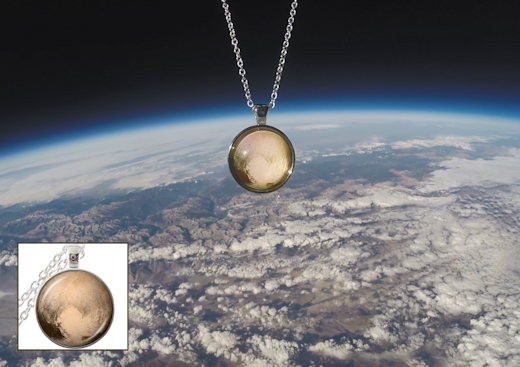
On Oct 11th the students of Earth to Sky Calculus launched this pendant to the edge of space using a high altitude cosmic ray balloon. It reached an altitude of 35.6 km (116,798 feet) above Earth's surface. You can have it for $119.95. The students are selling these pendants support their cosmic ray ballooning program.
Bonus: If you buy one this week, you may have a "Pluto is a Planet" Space Pendant free of charge.
Each pendant comes with a unique gift card showing the item at the edge of space and telling the story of its flight. Proceeds support Earth to Sky Calculus and hands-on STEM research.
Far Out Gifts: Earth to Sky Store
All sales support hands-on STEM education
FLOATING LIGHT PILLARS: On the night of Oct. 16th, Vincent Brady of Paradise, Michigan, went outside to look for auroras. He saw something similar--yet completely different. "There were colorful pillars of light floating over Whitefish Bay," he says. "What a pleasant surprise."
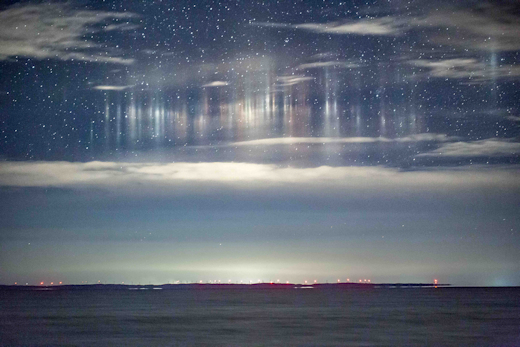
These pillars resemble auroras, but they have nothing to do with space weather. Light pillars are caused by ice crystals in the air which intercept manmade lights and spread them into colorful columns. No solar activity is required for the phenomenon. The only ingredients are ice and light pollution.
"The red lights are from wind turbines around the Canadian island Ile Parisienne," explains Brady. Other colors correspond to high pressure sodium lamps (warm orange) and modern LED lamps (blue-white).
Light pillars are a common sight at northern latitudes, especially when freezing winter air fills with crystals of ice. Normally, however, light pillars spring up from the ground where the urbans lights are located. "These were floating high above the ground," notes Brady. "That must have been where the ice crystals were on this early autumn night."