STEALTHY CME PROMPTS UNCERTAIN FORECAST: A very faint coronal mass ejection (CME) billowed away from the sun on Oct. 23th (1800 UT) following the collapse of a magnetic filament. The CME was so faint, in fact, that forecasters aren't sure how fast or in what direction it was moving. There is a slim chance of an Earth impact in the days ahead, worth mentioning only because CMEs often produce the best auroras. Mark this forecast uncertain. Free: Aurora Alerts.
THE DARK SIDE OF VENUS: Around the world today, amateur astronomers are very carefully observing the dark side of Venus. The second planet from the sun is passing almost directly between the sun and Earth, turning its night side toward us. Only a sliver of Venus remains illuminated in the daytime sky, shown here in a photo taken this morning by Steven Bellavia of Upton, NY:

"This is Venus at 0.6% illumination, as thin as it will get until June 2020," says Bellavia. "I took the picture using my Celestron C6 telescope."
Astronomers call this an "inferior solar conjunction of Venus." This is arguably the most beautiful time to observe Venus, but also the most perilous. The glare of the nearby sun magnified by a telescope can damage the eyes of anyone looking through the eyepiece.
Anthony J. Cook of the Griffith Observatory has some advice for observers: "I have observed Venus at conjunction, but only from within the shadow of a building, or by adding a mask to the front end of the telescope to fully shadow the optics from direct sunlight. This is tricky with a refractor or a catadioptric, because the optics start at the front end of the tube. Here at Griffith Observatory, I rotate the telescope dome to make sure the lens of the telescope is shaded from direct sunlight, even through it means that the lens will be partially blocked when aimed at Venus. With our Newtonian telescope, I add a curved cardboard mask at the front end of the tube to shadow the primary mirror."
The horns of the crescent might actually touch when the Venus-sun angle is least (~6 degrees) on Oct. 26th. Stay tuned!

LASER-ETCHED MOON CUBE: Last month, the students of Earth to Sky Calculus launched a cosmic ray balloon to the stratosphere. This unique laser-etched Moon cube went along for the ride, ascending to an altitude of 101,140 feet:
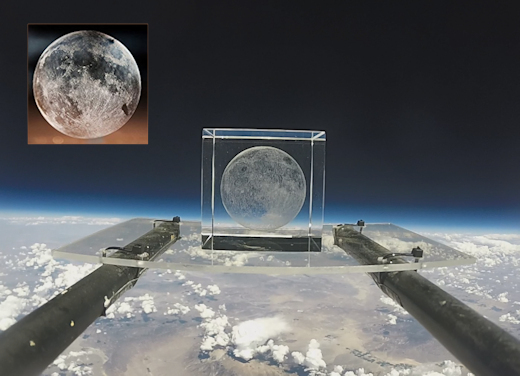
You can have it for $99.95. The students are selling these cubes as a fund-raiser for their cosmic ray ballooning program. It's an authentic representation of the Moon, with all of the craters, mountains and lava plains accurately portrayed.
Each Moon-cube comes with a unique gift card showing the item floating at the top of Earth's atmosphere. The interior of the card tells the story of the flight and confirms that this gift has been to the edge of space and back again.
Far Out Gifts: Earth to Sky Store
All sales support hands-on STEM education
ATMOSPHERIC COSMIC RAYS ARE INCREASING: So you thought Solar Minimum was boring? Think again. High-altitude balloon flights conducted by Spaceweather.com and Earth to Sky Calculus show that atmospheric radiation is intensifying from coast to coast over the USA--an ironic result of low solar activity. Take a look at the data:

Above: Dose rates at the Regener-Pfotzer Maximum, ~65,000 ft high at the entrance to the stratosphere.
Since 2015, we have been monitoring X-rays, gamma-rays and neutrons in the stratosphere--mainly over central California, but also in a dozen other states (NV, OR, WA, ID, WY, KS, NE, MO, IL, ME, NH, VT). Everywhere we have been there is an upward trend in radiation--ranging from +20% in central California to +33% in Maine. The latest points, circled in red, were gathered during a ballooning campaign in August-October 2018.
How does Solar Minimum boost radiation? The answer lies in the yin-yang relationship between cosmic rays and solar activity. Cosmic rays are the subatomic debris of exploding stars and other violent events. They come at us from all directions, 24/7. Normally, the sun's magnetic field and solar wind hold cosmic rays at bay--but during Solar Minimum these defenses weaken. Deep-space radiation surges into the solar system.

Cosmic rays crashing into our planet's atmosphere produce a spray of secondary particles and photons. That secondary spray is what we measure. Each balloon flight, which typically reaches an altitude greater than 100,00o feet, gives us a complete profile of radiation from ground level to the stratosphere. Our sensors sample energies between 10 keV and 20 MeV, spanning the range of medical X-ray machines, airport security devices, and "killer electrons" in Earth's radiation belts.
Who cares? For starters, anyone who flies. Cosmic radiation at aviation altitudes is typically 50 times that of natural sources at sea level. Pilots are classified as occupational radiation workers by the International Commission on Radiological Protection (ICRP) and, according to a recent study from researchers at the Harvard School of Public Health, flight attendants face an elevated risk of cancer compared to members of the general population. They listed cosmic rays as one of several risk factors. Weather and climate may also be affected, with some research linking cosmic rays to to the formation of clouds and lightning. Finally, there are studies (one recently published in Nature) asserting that heart rate variability and cardiac arrhythmias are affected by cosmic rays in some populations. If true, it means the effects reach all the way to the ground.
As 2018 comes to an end, Solar Minimum appears to be just getting started. Cosmic rays could continue to increase for years to come, so stay tuned. A sharable version of this story is available here.
Realtime Space Weather Photo Gallery