AURORAS FOR HALLOWEEN? The Arctic Circle could turn green on Halloween. Solar wind flowing from a hole in the sun's atmosphere is expected to reach Earth on Oct. 30th or 31st. Minor geomagnetic storms and auroras are possible when the gaseous material arrives. Free: Aurora Alerts.

A NEW SPACE WEATHER METRIC: The daily Thermosphere Climate Index (TCI) is now on Spaceweather.com. TCI is a relatively new space weather metric that tells us how the top of Earth's atmosphere (or "thermosphere") is responding to solar activity. During Solar Maximum, the top of our atmosphere heats up and expands. Right now the opposite is happening. Solar Minimum conditions are in effect, and this is causing the upper atmosphere to cool off:

TCI was invented by Martin Mlynczak of the Langley Research Center along with other NASA and university colleagues. For the past 17 years they have been using the SABER instrument onboard NASA's TIMED satellite to monitor the wattage of infrared emissions from the top of the atmosphere. Recently, they realized that those measurements could be used to summarize the state of the thermosphere in a single daily index, the TCI, expressed in watts (W). Moreover, they learned to calculate TCI going back in time all the way to the 1940s, thus placing current conditions in a historical context.
So where do we stand? Right now TCI=4.3x10¹⁰ W. That means the top of Earth's atmosphere is approximately 10 times cooler than it was during the record-setting Solar Max of 1957-58 (TCI=49.4x10¹⁰ W). The record low value for TCI, 2.1x10¹⁰ W, was set during the Solar Minimum of 2009. It's still not that cold in the thermosphere, although we're getting close.
You can monitor daily values of TCI right here on SpaceWeather.com. TCI not only tracks the slow progression of the 11-year solar cycle, but also it can change suddenly in response to solar flares and geomagnetic storms. As these events occur, we'll be writing about them to raise awareness of the many ways the sun can dump energy into Earth's atmosphere. Stay tuned!

Realtime Space Weather Photo Gallery
A MOONSTONE IN THE STRATOSPHERE: Are you looking for a far-out gift? Nothing says "I love you" like a moonstone from the edge of space. On June 12th, the students of Earth to Sky Calculus flew this moonstone wrapped in a sterling silver Celtic love knot 34.1 km (111,877 feet) above Earth's surface:
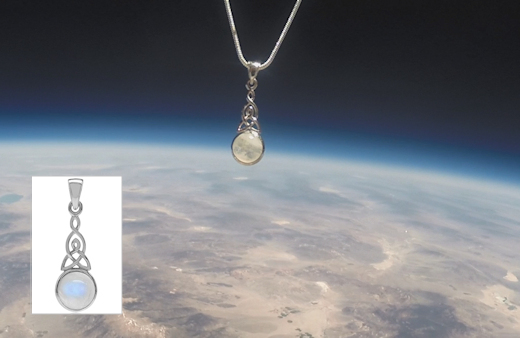
You can have it for $149.95. The students are selling these pendants to support their cosmic ray ballooning program. Each one comes with a greeting card showing the item in flight and telling the story of its journey to the edge of space. Sales support the Earth to Sky Calculus cosmic ray ballooning program and hands-on STEM research.
Far Out Gifts: Earth to Sky Store
All sales support hands-on STEM education
AFRICAN ICE HALO: You never know what you might see when you go on safari. "Earlier this week I was riding through Choose National Park in Botswana," says George Kourounis. "While the rest of the people in the vehicle were scanning the bushes, looking for lions and leopards, I was looking up in the sky at this complex solar halo."

"It was almost like a giant eye in the sky looking down at us," says Kourounis. "I've never seen anything like it."
Halos like this are caused ice crystals in high cirrus clouds. Shaped like pencils, long and thin with 6 sides, the crystals bend and refract sunlight into a variety of shapes. Shown above is a 22-degree circular halo, a circumscribed halo, and a fraction of a full parhelic circle.
Some people think ice halos are rare in Africa--but they are not. The air 10 km high is freezing over Africa just like everywhere else. Safari-goers should definitely look up, from time to time.