ARCTIC-GREEN HALLOWEEN: A stream of solar wind flowing from a small hole in the sun's atmosphere is approaching Earth. Estimated time of arrival: Oct. 31st. The gaseous material could create ghostly-green skies around the Arctic Circle for Halloween. Free: Aurora Alerts.

VENUS IS NOW A MORNING STAR: Last week, Venus passed by the sun, transitioning from the evening sky to the morning. Oleg Toumilovitch of Johannesburg, South Africa, may have been the first to spot the second planet in the rosy glow of sunrise. This is how Venus looked in the eyepiece of his telescope on Oct. 27th:

"I used the few minutes just before sunrise to safely bring Venus into the field of view of my telescope and recorded a short video as the first rays of the sun broke through thick atmosphere," says Toumilovitch. "Venus was only 4°48' above the horizon and 6°13' from the sun."
Like the Moon, Venus has phases. At the moment, it is a slender crescent. Venus's night side is turned toward Earth, leaving only a curved sliver visible as sunlight filters through the edge of the planet's acid cloudtops.
And if you think Venus looks a bit like a rainbow, you're right. "Atmospheric refraction at this low altitude splits the colors of Venus into red, green, and blue, producing a rainbow effect," notes Toumilovitch.
Realtime Space Weather Photo Gallery
PURPLE HEART SPACE PENDANT: Nothing says "I Love You" like a heart-shaped pendant from the edge of space. Last week, the students of Earth to Sky Calculus flew an array of cosmic ray sensors to the stratosphere onboard a giant helium balloon. This purple heart went along for the ride:
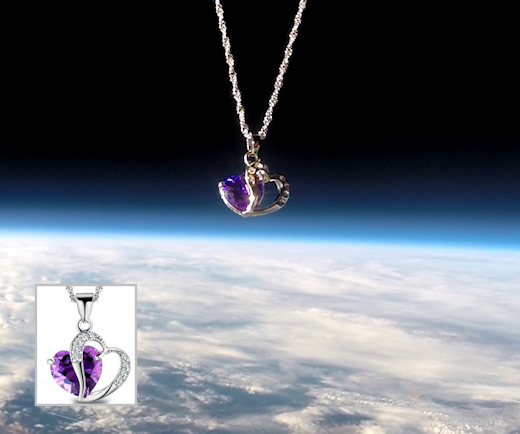
You can have it for $129.95. The students are selling these pendants as a fund-raiser for their cosmic ray monitoring program. They make great anniversary, birthday and Christmas gifts. Each pendant comes with a greeting card showing the jewelry in flight and telling the story of its journey to the stratosphere and back again.
Far Out Gifts: Earth to Sky Store
All sales support hands-on STEM education
METEOR DUST IN THE WIND: Talk about a lucky shot. On Oct. 11th, astrophotographer Michal Kaluzny of Nowy Belecin, Poland, was making a deep exposure of the constellation Orion when a bright fireball disintegrated beneath the Hunter's belt. The video is a must see.

Although this meteor cut across Orion, it was ironically not an Orionid. Orionid meteors come from Halley's Comet, and they emerge every October from a radiant near the Hunter's shoulder. Tracing the fireball's path backward, we can see that it came from another part of the sky. It was probably a random meteoroid scooped up by Earth while the Orionid meteor shower was coincidentally active.
Kaluzny's video did capture an authentic Orionid. It is the green flash at the 8-second mark. In addition "The light lines moving in the frame are geostationary satellites," adds Kaluzny. "And the green color of the sky is air glow." A busy night indeed.