ARCTIC-GREEN HALLOWEEN: A stream of solar wind flowing from a small hole in the sun's atmosphere is approaching Earth. Estimated time of arrival: Oct. 31st. The gaseous material could create ghostly-green skies around the Arctic Circle for Halloween. Free: Aurora Alerts.

SPACECRAFT MAKES RECORD CLOSE-APPROACH TO THE SUN: NASA's Parker Solar Probe is now closer to the sun than any other spacecraft in history, shattering the previous record of 26.6 million miles set by the Helios 2 spacecraft in 1976. The probe is now well inside the orbit of Mercury.
"It's a proud moment for our team," says Project Manager Andy Driesman of the Johns Hopkins Applied Physics Laboratory.

Count to 3. Parker just broke the record again. The spacecraft is accelerating sunward for the mission's first perihelion on Nov. 5th. At closest approach, the solar disk will seem 6 times wider than it does on Earth as the probe is hit by "brutal heat and radiation" (NASA's words). Parker's carbon-composite heat shield is expected to heat up to a sizzling 2000 deg. F.
Parker's prime mission is to investigate the origin of the solar wind--a project best done uncomfortably close to the star. Parker will trace the solar wind back to its source and find out how it escapes the sun's gravity and magnetic confinement.
Russell Howard of the Naval Research Laboratory expects to learn a lot from this encounter. "We might detect magnetic islands in the solar wind, which have been theoretically predicted. And if a CME (solar explosion) happens or a comet passes through the sun's atmosphere while we are so nearby, it could be spectacular."

"We lose communication with the spacecraft during the perihelion period which begins next week," notes Howard. "This is because there isn't sufficient power to drive both the instruments and the transmitter. The first dump of data will occur in early December." Stay tuned for that.
Parker will plunge toward the sun 24 more times in the next 8 years, breaking many records en route. Here's the timeline.
Realtime Space Weather Photo Gallery
PURPLE HEART SPACE PENDANT: Nothing says "I Love You" like a heart-shaped pendant from the edge of space. Last week, the students of Earth to Sky Calculus flew an array of cosmic ray sensors to the stratosphere onboard a giant helium balloon. This purple heart went along for the ride:
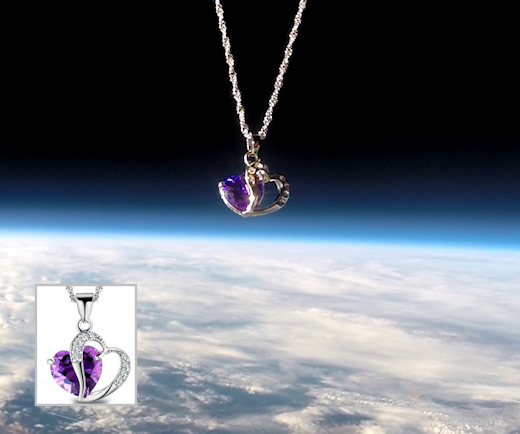
You can have it for $129.95. The students are selling these pendants as a fund-raiser for their cosmic ray monitoring program. They make great anniversary, birthday and Christmas gifts. Each pendant comes with a greeting card showing the jewelry in flight and telling the story of its journey to the stratosphere and back again.
Far Out Gifts: Earth to Sky Store
All sales support hands-on STEM education
METEOR DUST IN THE WIND: Talk about a lucky shot. On Oct. 11th, astrophotographer Michal Kaluzny of Nowy Belecin, Poland, was making a deep exposure of the constellation Orion when a bright fireball disintegrated beneath the Hunter's belt. The video is a must see.

Although this meteor cut across Orion, it was ironically not an Orionid. Orionid meteors come from Halley's Comet, and they emerge every October from a radiant near the Hunter's shoulder. Tracing the fireball's path backward, we can see that it came from another part of the sky. It was probably a random meteoroid scooped up by Earth while the Orionid meteor shower was coincidentally active.
Kaluzny's video did capture an authentic Orionid. It is the green flash at the 8-second mark. In addition "The light lines moving in the frame are geostationary satellites," adds Kaluzny. "And the green color of the sky is air glow." A busy night indeed.