POLAR GEOMAGNETIC UNREST: Earth is entering a minor stream of solar wind on Oct. 31st. The encounter will not spark full-fledged geomagnetic storms, but it may be enough to ghostly green auroras around the Arctic Circle on Halloween night. Free: Aurora Alerts.
HALLOWEEN MEMORIES: Halloween brings special memories to longtime aurora photographer Dave Parkhurst of Alaska. "15 years ago last night and tonight, huge aurora storms covered the Earth!" he recalls. "The skies above Alaska were particularly stunning."
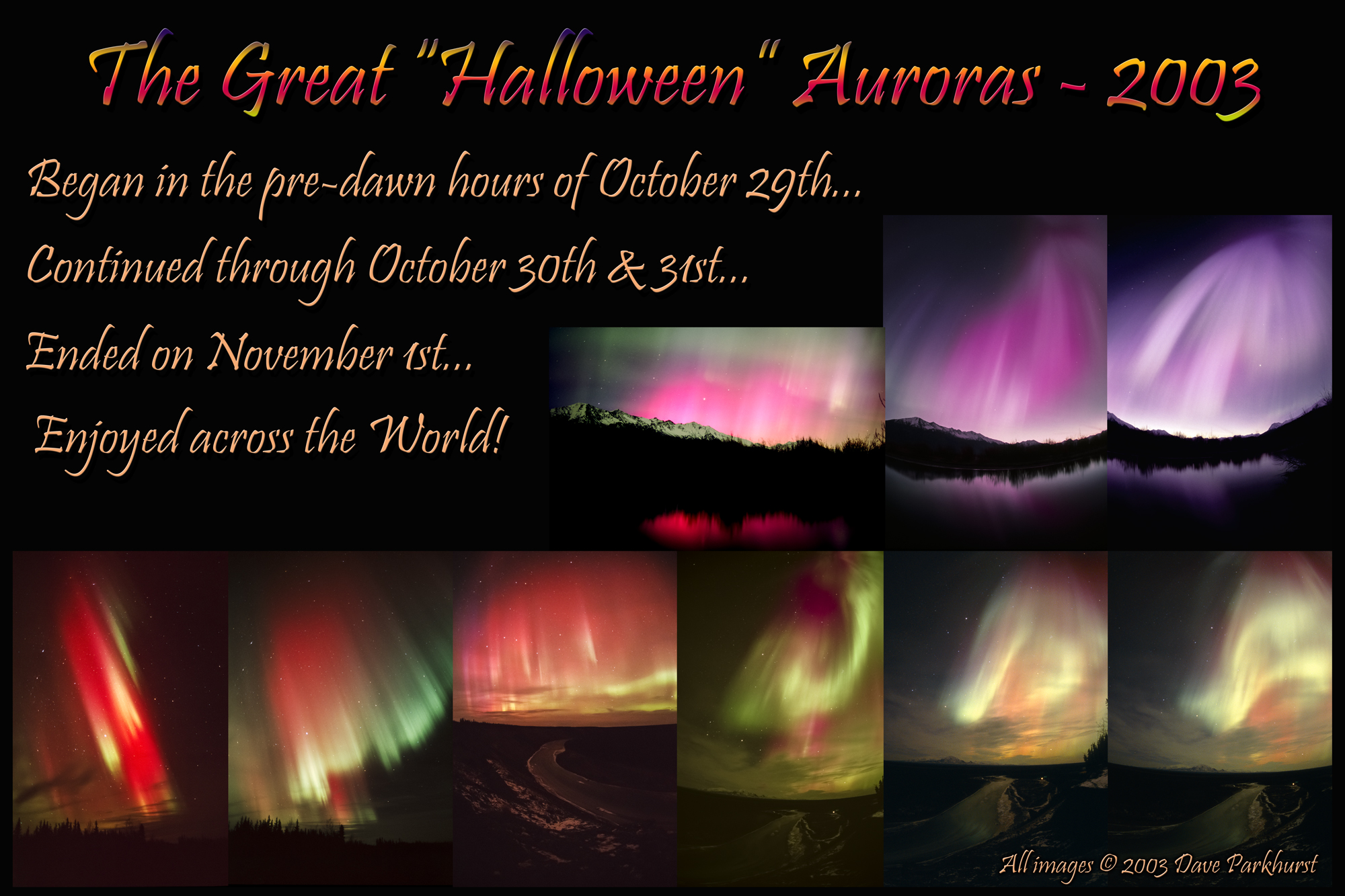
Halloween 2003 was a milestone in modern space weather. From Oct. 19th through Nov. 7th 2003, there were 17 major eruptions on the sun, including a record-setting X28 flare. One after another, CMEs (coronal mass ejections) slammed into Earth's magnetosphere, causing geomagnetic storms and Northern lights seen as far south as Florida and Texas. On Halloween itself, many trick or treaters witnessed blood-red auroras--very spooky indeed.
Parkhurst recalls the geomagnetic indices going wild. "A-indices powered up to 199 and K-indices were in the range 7 to 9 for a 48 hour period," he says. "We haven't seen anything like it since."
"This next Solar Cycle 25 will be my 5th cycle since I started photographing auroral displays in 1980. A majority of aurora chasers today are relatively new to the game, including newly booming high latitude 'Aurora Tours' that help people fulfill their bucket lists. They have yet to experience a really powerful Solar Maximum. When Solar Cycle 25 finally decides to ramp up in a year or two hopefully there will be some huge storms to thrill and put things into perspective regarding the scary power of the sun."
THE GREAT SPACE PUMPKIN: It's the spookiest space weather balloon mission ever. Last October, the students of Earth to Sky Calculus launched a pumpkin to the edge of space. The Jack O'Lantern flew to a record-setting altitude of 107,284 feet before parachuting back to Earth, landing on the verge of Death Valley National Park.
To make this happen, the students completely redesigned their usual space weather balloon payload, replacing the cosmic ray capsule with a pumpkin. A test flight on Oct. 15th verified the operation of the pumpkin's flight computer, camera, and GPS trackers. After making a few improvements, the stage was set for the Great Pumpkin Balloon Launch on Oct. 22nd. The space pumpkin reached a GPS-verified altitude of 107,284 feet, which we believe is a record.
Not only was the flight tons of fun, it taught us how to operate our hardware outside the warm confines of our usual payload. These new capabilities are coming in handy as we brainstorm new and exciting missions in the future. Happy Halloween!
Far Out Gifts: Earth to Sky Store
All sales support hands-on STEM education
VAN GOGH CLOUDS IN FINLAND: As a photographer living in Finland, Matti Helin is no stranger to swirling colors in the sky. He sees them all the time during geomagnetic storms. But the colors he witnessed on Oct. 29th were not auroras. Helin snapped this picture of "van Gogh clouds":
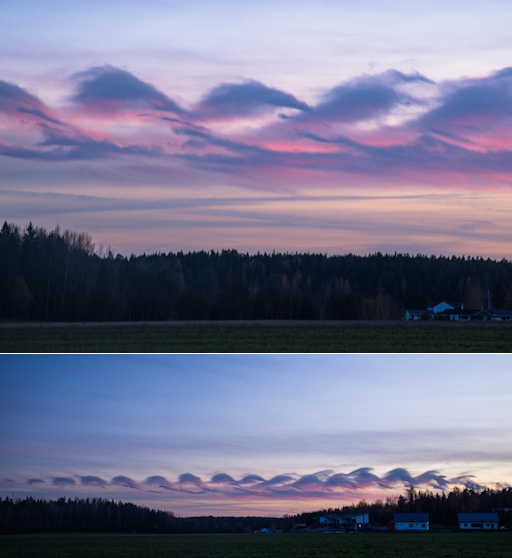
That's right, Vincent van Gogh.
These clouds, also known as "billow clouds," are produced by the Kelvin-Helmholtz instability when horizontal layers of air brush by one another at different velocities. It is widely believed that these waves in the sky inspired the swirls in van Gogh's masterpiece The Starry Night.
In this case, the clouds were traced by the motion of air and painted by the colors of the Arctic sunset. Helin's video of the phenomenon sets the canvas in motion. Watch it on Youtube.
Realtime Space Weather Photo Gallery