CO-ROTATING INTERACTION REGION: Later today, a co-rotating interaction region (CIR) is expected to hit Earth's magnetic field. CIRs are transition zones between slow- and fast-moving streams of solar wind. They contain density gradients and compressed magnetic fields that often do a good job sparking auroras. As a result of this CIR, NOAA forecasters say there is a 45% chance of minor G1-class geomagnetic storms on Nov. 3rd and 4th. Free: Aurora Alerts.

A SIGN OF SOLAR MINIMUM: HOLES IN THE SUN'S ATMOSPHERE During solar minimum, sunspots disappear. This brings a temporary end to solar flares and coronal mass ejections--the explosive triggers of space weather. But that does not mean space weather ends. A sunspots disappear, holes begin to open in the sun's atmosphere, spewing solar wind. One of these holes is facing Earth now:

This is a coronal hole--a place in the sun's atmosphere where magnetic fields open up and allow solar wind to escape. Streams of solar wind flowing from these holes lash Earth's magnetic field, causing geomagnetic storms. A solar wind stream from a coronal hole is not as fierce as a solar flare or a CME--but it can do a good job sparking high-latitude auroras.
Studies show that coronal holes not only open more frequently when sunspots are absent, but also last longer. During the last solar minimum in 2007-2009, one coronal hole stayed open for 27 consecutive solar rotations. As the sun slowly turned on its axis, that hole fire-hosed Earth with a stream of solar wind almost once a month for nearly two years. For comparison, this coronal hole has only been around five times. It is a youngster.
Sometimes the leading edges of solar wind streams from coronal holes contain CIRs--that is, co-rotating interaction regions. CIRs are like mini-CMEs. They contain shock-like density gradients and magnetic fields that can do a good job sparking G1 and G2-class geomagnetic storms. Such a CIR is en route to Earth now, prompting NOAA forecasters to issue a minor Geomagnetic Storm Watch (G1-class) for Nov. 3rd and 4th. Free: Aurora Alerts.

FLY ME TO THE MOONSTONE: Are you looking for a far-out gift? Nothing says "I love you" like a moonstone from the edge of space. On Jan 27th, the students of Earth to Sky Calculus flew this moonstone wrapped in a hand-crafted sterling silver Celtic love knot 35.1 km (115,158 feet) above Earth's surface:
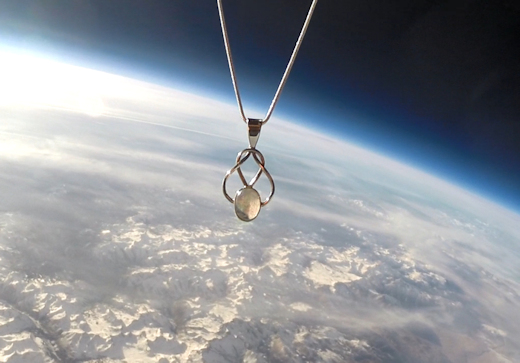
You can have it for $179.95. The students are selling these pendants to support their cosmic ray ballooning program. Each one comes with a greeting card showing the item in flight and telling the story of its journey to the edge of space. All sales support the Earth to Sky Calculus cosmic ray ballooning program and hands-on STEM research.
Far Out Gifts: Earth to Sky Store
All sales support hands-on STEM education