GEOMAGNETIC STORM IN PROGRESS: Almost a day later than expected, Earth is entering a stream of solar wind flowing from a large hole in the sun's atmosphere. G1-class geomagnetic storms are in progress. Such storms are considered minor, but they can cause auroras in the USA as far south as a line between Maine and Washington. High-latitude sky watchers should be alert for the glow of geomagnetic activity in the midnight sky. Free: Aurora Alerts.


First contact with the stream produced an outburst of lights over Dafjord, Norway, shown here in a photo taken by Michael P. Zawadzki:

"I observed through a brief opening in the clouds above Dafjord, about an hour away from Tromso," says Zawadzki. "The auroras started out tepid and slow, but soon exploded with bright activity."
The ongoing storm is also causing electrical currents to flow through the ground in Norway. Rob Stammes of the PolarLightCenter recorded them in the Lofoten Islands.
FLY ME TO THE MOONSTONE: Are you looking for a far-out gift? Nothing says "I love you" like a moonstone from the edge of space. On Jan 27th, the students of Earth to Sky Calculus flew this moonstone wrapped in a hand-crafted sterling silver Celtic love knot 35.1 km (115,158 feet) above Earth's surface:
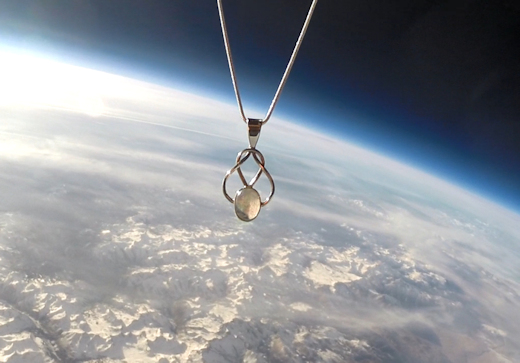
You can have it for $179.95. The students are selling these pendants to support their cosmic ray ballooning program. Each one comes with a greeting card showing the item in flight and telling the story of its journey to the edge of space. All sales support the Earth to Sky Calculus cosmic ray ballooning program and hands-on STEM research.
Far Out Gifts: Earth to Sky Store
All sales support hands-on STEM education
A FIREBALL OVER PUERTO RICO: On Friday night, something exploded in the sky above Puerto Rico. "A large meteor lit up the sky just west of the island," says Frankie Lucena, whose automated meteor camera recorded the flash:

"According to my software, the brightness of the explosion was magnitude -7.4, or about 20 times brighter than Venus," he says. "Any surviving fragments could have splashed down (or made landfall) between Puerto Rico and the Dominican Republic."

What was it? Using a sky map, Lucena traced the meteor's path back to its origin--not far from the constellation Taurus. Indeed, it may be a Taurid.

This is the time of year for Taurid fireballs. Every November, Earth crosses through a broad stream of debris from Comet Encke. The resulting drizzle of meteors emerging from the horns of Taurus is remarkable because Comet Encke produces fireballs--meteors so bright that they can cast shadows on the ground.

Above: Comet Encke observed by NASA's STEREO spacecraft in 2007.
Debris from Comet Encke isn't like that of other comets. The stream is rich in particles about the size of pebbles or small stones--much larger than normal comet dust. Some of these gravelly meteoroids travel in swarms that cause outbursts of fireballs every 7 years or so, most recently in 2015.
Encke's debris might be unusual because it is actually detritus from the breakup of a much larger comet ~30 thousand years ago. At least two small asteroids (2015 TX24 and 2005 UR) share the approximate orbits of Taurid gravel swarms, and there may be other small space rocks hiding in the stream as well. It all bespeaks a catastrophic event in the past--and potentially spectacular fireballs in the future. Every night in the next two weeks is a good time to look as Earth crosses the zone of debris. [sky map]

Realtime Space Weather Photo Gallery