CHANCE OF GEOMAGNETIC STORMS: A large hole in the sun's atmosphere is facing Earth, sending a stream ofsolar wind toward our planet. Estimated time of arrival: Nov. 10th. NOAA forecasters say there is a 55% to 60% chance of minor G1-class geomagnetic storms when the stream arrives. High-latitude sky watchers should be alert for auroras tomorrow night. Free: Aurora Alerts.


A BLAST FROM THE PAST (WARTIME SPACE WEATHER IN VIETNAM): On Aug. 2nd, 1972, giant sunspot MR11976 began to explode. For the next 2 days it unleashed a series of X-class flares, causing deep radio blackouts on Earth and punishing the solar panels and onboard electronics of satellites in Earth orbit. One CME (cloud of plasma) rocketed across the sun-Earth divide in only 14.6 hours--a record that still stands today. Resulting geomagnetic storms sparked auroras so bright, they cast shadows in countries as far south as Britian.

Above: Images of giant sunspot MR11976 from the Paris Observatory. [more]
The 1972 solar storm is legendary at NASA because it occurred in between two Apollo missions: the crew of Apollo 16 had returned to Earth in April and the crew of Apollo 17 was preparing for a moon landing in December. If the timing had only been a little different, astronauts could have been sickened by radiation, requiring an emergency return home for medical attention.
Turns out, it's legendary in the Navy, too. According to a research paper just accepted for publication in the journal Space Weather, declassified Naval archives reveal an extraordinary explosion in the sea lanes near Vietnam: "On 4 August (1972) TF-77 aircraft reported some two dozen explosions in a minefield near Hon La over a 30-second time span...Ultimately the Navy concluded that the explosions had been caused by the magnetic perturbations of solar storms, the most intense in more than two decades."

Above: A magnetogram from Manilla reveals unusual disturbances on Aug. 4-5, 1972. [more]
The authors, led by Delores Knipp of the University of Colorado, continue: "Aerial inspections revealed additional evidence of detonations elsewhere along the coast. The wartime memoirs of a US Navy Mineman-Sailor, Chief Petty Officer Michael Gonzales,state: 'During the first few weeks of August, a series of extremely strong solar flares caused a fluctuation of the magnetic fields, in and around, South East Asia. The resulting chain of events caused the premature detonation of over 4,000 magnetically sensitive [mines].'"
This prompted the Navy to fast-track the replacement of magnetic-influence-only mines with mines that also required seismic or acoustic triggers during periods of high solar activity.
The August 1972 storms affected Earth in ways that are are only now being fully understood almost 50 years later. Moreover, Knipp and colleagues say the storms could be a previously-unrecognized example of an extreme Carrington-class event, and they urge further scrutiny. Given the experience of the US Navy, who can argue? Read the original research here.
Realtime Space Weather Photo Gallery
PURPLE HEART SPACE PENDANT: Nothing says "I Love You" like a heart-shaped pendant from the edge of space. Last week, the students of Earth to Sky Calculus flew an array of cosmic ray sensors to the stratosphere onboard a giant helium balloon. This purple heart went along for the ride:
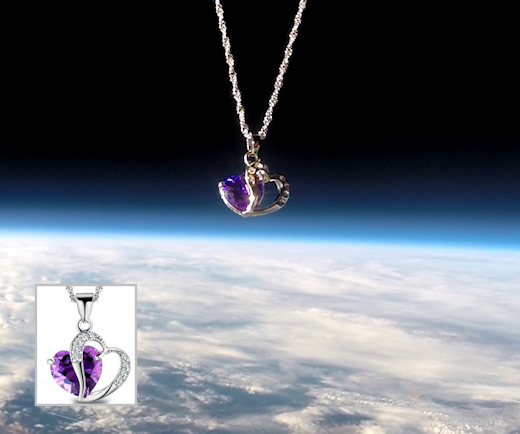
You can have it for $129.95. The students are selling these pendants as a fund-raiser for their cosmic ray monitoring program. They make great anniversary, birthday and Christmas gifts. Each pendant comes with a greeting card showing the jewelry in flight and telling the story of its journey to the stratosphere and back again.
Far Out Gifts: Earth to Sky Store
All sales support hands-on STEM education